Leadership Lessons from Iconic CEOs Around the World
Updated: 7 Sep 2026
Leadership Lessons from Iconic CEOs continue to inspire entrepreneurs, founders, and business leaders across the world because they reveal how bold ideas turn into lasting impact. By studying the journeys of globally recognised CEOs, we begin to understand that success is rarely accidental. It is built through vision, discipline, and courage to make difficult decisions when the future is uncertain.
Many of the world’s most respected companies were shaped by leaders who thought differently from the crowd. They challenged industry norms, embraced innovation, and stayed committed to long-term goals even when short-term results looked discouraging. These patterns appear again and again in the stories of iconic CEOs, offering practical guidance for anyone trying to build something meaningful.
What makes these leadership lessons especially powerful is that they are not limited to billion-dollar corporations. The same principles, clear vision, customer focus, resilience, and continuous learning, can be applied to small businesses, startups, and personal career growth. Great leadership is less about position and more about mindset and daily habits.
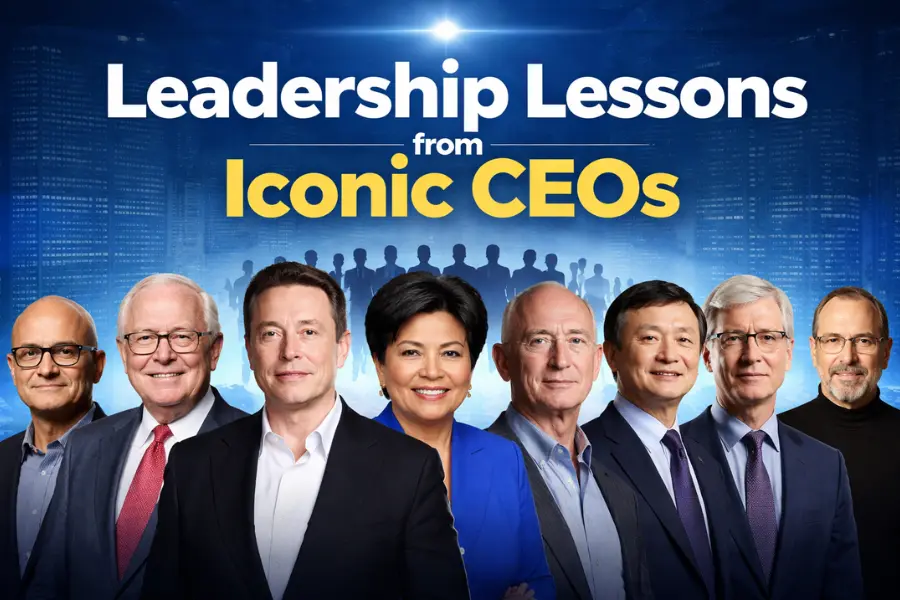
In this article, we will explore key leadership lessons from iconic CEOs around the world and translate their experiences into actionable insights you can use in your own journey. Whether you are launching your first venture or leading an established team, these lessons can help you think bigger, lead smarter, and grow with purpose.
Leadership Lessons from Iconic CEOs
The most valuable leadership lessons from iconic CEOs come from the way they think, decide, and respond to challenges rather than from their titles or wealth. These global business leaders built influence by staying committed to a clear vision, making bold yet calculated decisions, and maintaining strong focus during uncertainty. Their journeys show that real leadership is not about controlling people; it is about guiding direction, inspiring trust, and creating long-term value that continues even after they step away.
Across different industries and cultures, iconic CEOs consistently demonstrate a few shared qualities: resilience in failure, deep understanding of customers, willingness to innovate, and discipline to think long term. Whether leading a technology giant, an investment firm, or a global consumer brand, they prioritise sustainable growth over quick success. This mindset allows their companies to survive market changes, adapt to disruption, and remain relevant for decades instead of just a few profitable years.
For modern entrepreneurs and small business owners, these lessons are highly practical. You may not have global resources or massive funding, but you can still apply the same principles by setting a strong mission, building a customer-focused strategy, and developing the habit of continuous learning. In reality, the distance between a startup founder and a world-class CEO is often defined more by mindset, discipline, and consistency than by money or opportunity.
Understanding these leadership lessons from iconic CEOs is the first step toward building a business that lasts. When leaders combine vision, discipline, empathy, and innovation, they create organisations that do more than generate profit. They shape industries, influence society, and define the future of business.
What it takes to be a great leader | Roselinde Torres | TED

Clear Vision Creates Direction
Every iconic CEO begins with a powerful and clear vision. Vision acts as a compass that guides decisions, priorities, and long-term strategy. Without direction, even talented teams lose focus. With direction, ordinary teams can achieve extraordinary outcomes because everyone understands the larger purpose behind daily work.
For entrepreneurs, this means defining what problem you truly want to solve and staying committed to that purpose even when trends change or competitors appear.
Resilience Turns Failure into Progress
Failure is a common chapter in the journey of global business leaders. What separates iconic CEOs from others is not the absence of failure but their response to it. They treat setbacks as feedback and learning opportunities, allowing each mistake to strengthen future decisions.
Small business owners can apply this mindset by viewing challenges as temporary lessons rather than permanent defeat. Persistence, combined with learning, often becomes a powerful competitive advantage.
Customer Focus Builds Lasting Trust
Another defining trait in the leadership lessons from iconic CEOs is deep customer understanding. Great leaders invest time in knowing what customers truly need, not just what they say they want. This focus leads to better products, stronger loyalty, and long-term brand trust.
Businesses that consistently solve real human problems rarely struggle to find growth opportunities.
Long-Term Thinking Creates Sustainable Success
Iconic CEOs think in years and decades, not just months or quarters. They are willing to sacrifice short-term comfort to achieve long-term stability and impact. This patience allows innovation, reputation, and customer relationships to grow naturally over time.
Entrepreneurs who adopt long-term thinking often build businesses that are stronger, more trusted, and more resilient during economic uncertainty.
Steve Jobs: Vision, Focus, and the Courage to Simplify
One of the most powerful leadership lessons from iconic CEOs comes from Steve Jobs, whose approach to innovation not only transformed Apple but also reshaped the technology industry as a whole. Jobs demonstrated that leadership is about clarity, discipline, and vision, not just creativity or technical knowledge.
Focus Over Expansion
Jobs believed that focus was more important than expansion. Instead of trying to do everything, Apple concentrated on a handful of products and perfected them. He famously eliminated good ideas to give space for great ideas to thrive. This teaches entrepreneurs that success often comes not from quantity but from quality and strategic prioritization.
Avoid spreading resources too thin. Identify the few initiatives that will make the biggest impact and dedicate your energy there.
The Power of Simplicity
A hallmark of Jobs’ leadership was his obsession with simplicity in design and experience. He understood that customers rarely fall in love with complexity. They gravitate toward products that are intuitive, elegant, and meaningful. Apple’s minimalist designs, smooth interfaces, and clear messaging all reflect this philosophy.
Entrepreneur insight:
Simplicity requires discipline. Streamline processes, products, and messaging so that your audience can easily understand and connect with your brand.
Courage to Trust Your Vision
Jobs’ leadership also shows that courage is essential. He often pursued ideas that others considered risky or impossible, from the iPhone to the MacBook Air. His belief in his vision, even when doubted, allowed Apple to achieve breakthroughs that competitors could not replicate.
Lesson for founders:
Leadership often involves going against conventional wisdom. Trust your instincts while balancing calculated risks.
Focused Excellence for Entrepreneurs
For modern founders, the takeaway is straightforward: do fewer things, but do them exceptionally well. Whether it’s refining a product, building a team, or developing a customer experience, concentrated effort often produces disproportionate results.
Jobs’ approach proves that true leadership is less about doing more and more about doing the right things with excellence, clarity, and vision.
Elon Musk: Risk, Resilience, and Thinking Beyond the Present
While Steve Jobs refined the present, Elon Musk focuses relentlessly on the future. From electric vehicles with Tesla to reusable rockets with SpaceX, Musk builds companies around problems that truly matter to humanity, such as sustainable energy and interplanetary exploration. This long-term vision highlights one of the most important leadership lessons from iconic CEOs in the modern era: think beyond immediate gains and focus on transformative impact.
Solving Meaningful Problems
Musk’s leadership is defined by his commitment to tackling high-impact problems rather than chasing short-term profits. Tesla was not just about selling cars; it was about accelerating the world’s transition to sustainable energy. SpaceX was not just about rockets; it was about making life multi-planetary.
Entrepreneur insight:
Ask yourself: “Am I solving a small, safe problem, or a meaningful one?” The latter often requires more risk but delivers far greater rewards and purpose.
Embracing Risk and Failure
Musk’s journey has been marked by near bankruptcy, public criticism, and repeated failures. Rockets exploded, car production faced massive delays, and critics constantly doubted his vision. Yet, his persistence and resilience transformed these challenges into lessons, driving innovation forward.
Extraordinary success almost always requires extraordinary risk. Avoiding all risk often leads to mediocrity, while calculated risk can create breakthrough opportunities.
Inspiring Teams Through Big Visions
Musk also demonstrates that big, audacious goals motivate teams. Employees are not just working for a paycheck. They are contributing to a mission that feels meaningful on a global scale. This inspires high performance, creativity, and loyalty, which are essential for building sustainable companies.
Actionable insight:
Craft a vision that excites both your team and your customers. A compelling purpose multiplies effort and drives long-term commitment.
Takeaways for Modern Entrepreneurs
Elon Musk’s story reinforces several leadership lessons from iconic CEOs:
- Focus on meaningful, high-impact problems.
- Be willing to take calculated risks and embrace failure as learning.
- Use vision to inspire your team and align efforts toward a common goal.
When combined, these traits help entrepreneurs think bigger, act bolder, and create lasting impact, even when starting from scratch.
Satya Nadella: Empathy, Culture, and Continuous Reinvention
When Satya Nadella became CEO of Microsoft in 2014, the company did not urgently need a financial rescue. It needed a cultural transformation. Nadella understood that even a profitable company can stagnate without the right mindset, collaboration, and purpose. His leadership provides one of the clearest lessons from iconic CEOs about the power of culture and empathy in driving innovation.
Building a Growth-Oriented Culture
Nadella introduced a growth mindset across Microsoft, encouraging employees to learn, adapt, and collaborate instead of competing internally or protecting their egos. This cultural shift led to better teamwork, faster problem-solving, and more innovative thinking.
Entrepreneur insight:
Culture is not a luxury. It’s a strategic asset. Small businesses and startups should prioritise values, communication, and collaboration to create a motivated, aligned team.
Empathy as a Leadership Strength
Another defining trait of Nadella’s leadership is empathy. He believes that understanding employees, customers, and partners is not “soft,” but a critical driver of innovation and trust. By listening and connecting on a human level, he created an environment where ideas could flourish, and challenges were approached collaboratively.
Actionable takeaway:
Practising empathy allows leaders to anticipate customer needs, improve team performance, and foster loyalty, a principle that works across industries and business sizes.
Continuous Reinvention and Innovation
Under Nadella’s leadership, Microsoft successfully pivoted into cloud computing, artificial intelligence, and subscription-based software, proving that even established companies must continuously evolve. Reinvention became part of the company’s DNA, allowing Microsoft to remain a global leader decades after its founding.
Lesson for business owners:
Never become complacent. Encourage your team to experiment, learn from failures, and embrace change to remain competitive in a dynamic market.
Key Takeaways for Entrepreneurs
Satya Nadella’s journey reinforces several leadership lessons from iconic CEOs that are practical for any business:
- Culture drives performance: Align values, communication, and collaboration.
- Empathy strengthens leadership: Understand your team, customers, and stakeholders.
- Reinvention is essential: Innovate and adapt before disruption forces change.
By combining empathy, culture, and continuous learning, entrepreneurs can create a resilient and innovative organization capable of long-term growth and impact.
Jeff Bezos: Customer Obsession and Long-Term Strategy
One of the most influential leadership lessons from iconic CEOs comes from Jeff Bezos, the founder of Amazon. Bezos built one of the world’s most valuable companies by making relentless customer focus the cornerstone of every decision. Rather than fixating on competitors, he constantly asked: “How can we serve customers faster, cheaper, and better?”
Customer Obsession as a Core Principle
Bezos’ approach demonstrates that truly customer-centric companies outperform their competitors. At Amazon, every decision from product selection to delivery speed revolves around the customer experience. This obsession ensures loyalty, repeat business, and organic growth.
Entrepreneur insight:
Focus on solving real customer problems. Even small startups can outperform larger competitors if they deeply understand and serve their audience better.
Long-Term Thinking Pays Off
Equally important is Bezos’ commitment to long-term strategy. Amazon’s groundbreaking innovations, such as Amazon Prime, AWS, and advanced logistics networks, took years to become profitable. Short-term thinkers might have abandoned these projects early, but Bezos’s patience created massive competitive advantages.
Lesson for business owners:
Avoid chasing quick wins that compromise long-term growth. Sustainable success often comes to those who can experiment, fail, and persist over time.
Balancing Experimentation and Risk
Amazon encourages a culture of experimentation where failure is expected and analysed. Bezos believes that innovation requires trying new approaches, even if some don’t succeed. This principle allows the company to continuously evolve and stay ahead of the market.
Actionable takeaway:
Entrepreneurs should test ideas, learn from mistakes, and iterate quickly, all while keeping a long-term vision in mind.
Key Takeaways for Entrepreneurs
From Jeff Bezos, modern business leaders can learn that:
- Customer obsession drives loyalty: Understand and anticipate your audience’s needs.
- Patience builds advantage: Think in years, not quarters, for sustainable growth.
- Experimentation fuels innovation: Embrace calculated risks and learn from failures.
By combining customer focus, long-term thinking, and experimentation, entrepreneurs can build businesses that not only survive but thrive in highly competitive markets.
Warren Buffett: Discipline, Trust, and the Power of Patience
Among the most instructive leadership lessons from iconic CEOs is the approach of Warren Buffett, the legendary investor and CEO of Berkshire Hathaway. Unlike fast-moving tech founders, Buffett demonstrates that calm, rational leadership combined with disciplined decision-making often produces more reliable and lasting success than chasing dramatic, high-risk moves.
Discipline Over Impulse
Buffett’s career shows the power of consistent, disciplined choices. He invests only in companies he understands, carefully evaluates opportunities, and avoids impulsive decisions based on market hype. This level of discipline ensures that his decisions are sustainable and low-risk, even when the market becomes volatile.
Entrepreneur takeaway:
Focus on strategic, well-researched decisions instead of jumping at every opportunity. Clear, consistent actions build stronger businesses over time.
Reputation and Integrity as Strategic Assets
Another key lesson from Buffett is that trust and integrity are invaluable in business. He famously said, “It takes 20 years to build a reputation and five minutes to ruin it.” For Buffett, maintaining ethical standards and keeping promises to partners, customers, and employees is as important as financial success.
Actionable insight:
Entrepreneurs should treat reputation as a critical asset. Being trustworthy can create opportunities that money alone cannot buy.
Patience Multiplies Results
Buffett’s investment strategy relies on long-term thinking and patience. He has held investments for decades, allowing compound growth to work its magic. He avoids chasing short-term gains that could jeopardize long-term stability.
Lesson for business owners:
Real wealth and sustainable success come from steady, patient progress rather than sudden wins or risky shortcuts.
Key Takeaways for Entrepreneurs
From Warren Buffett, business leaders can learn that:
- Discipline ensures consistency: Avoid impulsive or emotional decisions.
- Integrity builds trust: Your reputation is a strategic business asset.
- Patience creates compounding growth: Long-term thinking outperforms short-term excitement.
By combining discipline, trust, and patience, entrepreneurs can build resilient businesses that withstand market fluctuations and grow steadily over time.
Indra Nooyi: Purpose-Driven Leadership in a Global World
Among the most inspiring leadership lessons from iconic CEOs is the example set by Indra Nooyi, former CEO of PepsiCo. Nooyi demonstrated that strong leadership is not just about delivering financial results. It’s about balancing profit with purpose, ethics, and people-centred management. Her tenure shows that leaders can achieve both sustainable growth and positive social impact.
Profit with Responsibility
Nooyi pushed PepsiCo to develop healthier products and focus on sustainability initiatives while maintaining strong financial performance. She proved that companies do not need to sacrifice profits to do the right thing. In fact, integrating responsibility into business strategy often strengthens brand reputation and customer loyalty.
Entrepreneur insight:
Consider how your business can solve societal or environmental challenges alongside achieving financial goals. Purpose-driven companies often attract both loyal customers and top talent.
People-Centric Leadership
Nooyi believed that leadership extends beyond products and profits. It includes empowering employees, understanding their needs, and fostering a supportive culture. She was known for writing personalised letters to employees’ families to acknowledge their contributions, demonstrating that empathy and recognition can drive performance.
Actionable takeaway:
Prioritize your team’s well-being, development, and engagement. A motivated and respected workforce is one of the most powerful engines of growth.
Global Perspective and Adaptability
Leading a multinational company requires cultural awareness, strategic thinking, and adaptability. Nooyi’s global perspective allowed her to expand PepsiCo’s reach while respecting local markets and needs. This highlights an important lesson: leadership in a connected world demands both vision and cultural sensitivity.
Entrepreneur insight:
Even small businesses can benefit from understanding diverse customer preferences and adapting products or services accordingly.
Key Takeaways for Entrepreneurs
Indra Nooyi’s leadership teaches modern business leaders to:
- Integrate purpose with profit: Build businesses that contribute to society.
- Empathize with employees: Recognize, value, and empower your team.
- Think globally, act locally: Adapt strategies to diverse markets while maintaining core values.
By combining performance, ethics, and empathy, entrepreneurs can build brands that are not only profitable but also trusted, respected, and resilient.
Jack Ma: Resilience in the Face of Rejection
Among the most powerful leadership lessons from iconic CEOs is the journey of Jack Ma, the co-founder of Alibaba. Before building one of the world’s largest e-commerce empires, Jack faced repeated failures, rejection, and scepticism. He was turned down for jobs, including at KFC, and faced doubt from investors and peers alike. Yet, his persistence and optimism turned obstacles into stepping stones for success.
Viewing Rejection as Training, Not Failure
Jack Ma’s story shows that rejection is not the end. It’s preparation for bigger opportunities. Every “no” he received taught him lessons about perseverance, strategy, and communication, which later became critical for Alibaba’s growth.
Entrepreneur insight:
Treat setbacks as learning experiences. Each challenge can strengthen your skills, mindset, and resilience for the next opportunity.
Small Businesses and Empowerment
Jack Ma built Alibaba with the mission of empowering small businesses rather than competing solely with global giants. He understood that helping others succeed can create a larger ecosystem of growth and innovation, benefiting both customers and the company.
Actionable takeaway:
Focus on creating value for your customers and partners. Supporting others often leads to long-term partnerships and brand loyalty.
Optimism as a Competitive Advantage
Even in the face of criticism and doubt, Jack Ma maintained a positive and optimistic outlook. His belief in his vision and in the potential of his team kept Alibaba moving forward, proving that optimism can fuel perseverance, creativity, and leadership.
Entrepreneur insight:
Maintaining a positive mindset, even during difficult times, helps leaders inspire their teams, make better decisions, and see opportunities where others see obstacles.
Key Takeaways for Entrepreneurs
From Jack Ma, modern business leaders can learn that:
- Resilience turns failure into progress: Treat setbacks as lessons.
- Empower others to grow: Helping small businesses or partners creates broader success.
- Optimism fuels leadership: Belief in your vision keeps you moving forward.
By combining resilience, empowerment, and optimism, entrepreneurs can overcome obstacles and build businesses capable of global impact.
Tim Cook: Operational Excellence and Quiet Leadership
Another important set of leadership lessons from iconic CEOs comes from Tim Cook, who took the helm of Apple after Steve Jobs. Many doubted whether Apple could continue thriving without its visionary founder, but Cook proved that quiet, disciplined leadership combined with operational excellence can drive tremendous success. His approach highlights that leadership is not always about charisma. It’s about execution, consistency, and values.
Leading with Quiet Confidence
Unlike the larger-than-life presence of Jobs, Cook’s style is calm, deliberate, and understated. He demonstrates that leadership does not require constant attention or spectacle; rather, it thrives on reliability, clarity, and steady decision-making.
Entrepreneur insight:
You don’t need to be the loudest voice in the room. Consistency, clear communication, and calm problem-solving often earn more respect and trust from your team.
Operational Excellence as a Competitive Advantage
Cook’s greatest strength lies in streamlining operations. Apple’s supply chain innovations, efficient production, and careful attention to detail allowed the company to maintain high quality while scaling globally. This operational mastery became a core factor in Apple’s sustained profitability and market dominance.
Actionable takeaway:
Focus on process efficiency and execution. Even small improvements in operations can significantly boost productivity and customer satisfaction.
Values-Driven Leadership
Tim Cook emphasises ethical leadership, sustainability, and privacy as part of Apple’s core values. His commitment to principles has strengthened the brand and built deeper trust with customers and stakeholders. Leadership, Cook shows, is about aligning actions with values consistently over time.
Entrepreneur insight:
Incorporate your values into decision-making. Businesses that operate with integrity attract loyal customers, motivated employees, and long-term success.
Key Takeaways for Entrepreneurs
Tim Cook’s journey teaches business leaders that:
- Quiet leadership works: Reliability and clarity often outweigh charisma.
- Operational excellence drives growth: Streamline processes and focus on execution.
- Values strengthen brand trust: Align decisions with ethical principles and long-term goals.
By combining disciplined operations, values, and quiet confidence, entrepreneurs can lead their teams effectively, scale sustainably, and build a resilient, respected organisation.
Common Leadership Patterns Shared by Iconic CEOs
When we step back and analyse the journeys of these iconic CEOs, certain patterns and traits consistently appear. These traits are not limited to tech giants or multinational corporations. They apply to startups, small businesses, and personal leadership alike. Understanding these patterns can help any entrepreneur or business leader apply proven principles to their own work.
Vision Gives Direction
Every successful CEO begins with a clear, compelling vision. Vision acts as a roadmap that guides strategy, decision-making, and team alignment. Without it, even talented teams can lose focus; with it, ordinary teams can accomplish extraordinary results.
Entrepreneur insight:
Define a clear purpose for your business. Ask yourself: “What problem am I solving, and what impact do I want to create?” A strong vision motivates your team and provides a north star for growth.
Resilience Overcomes Failure
Failure is a common experience for every global leader. What sets iconic CEOs apart is their ability to bounce back, learn, and keep moving forward. Resilience transforms setbacks into opportunities and builds the mental toughness necessary for long-term success.
Actionable takeaway:
Treat challenges as lessons, not defeats. Reflect on failures, adjust your approach, and maintain confidence in your mission.
Customer or People Focus Builds Loyalty
From Bezos’s obsession with customer satisfaction to Nooyi’s employee-centered leadership, every great CEO prioritizes people, either customers, employees, or partners. Understanding needs, delivering value, and fostering trust are essential for long-term loyalty.
Entrepreneur insight:
Focus on creating meaningful experiences for your customers and nurturing your team. Loyalty and trust are built over time, and they become powerful assets for your business.
Long-Term Thinking Creates Stability
Iconic CEOs consistently think in years or decades, not months or quarters. Short-term gains can compromise sustainability, whereas long-term thinking allows innovation, relationship-building, and market leadership to compound over time.
Actionable takeaway:
Make decisions with the long game in mind. Plan beyond immediate profits and consider how today’s choices affect future growth.
Continuous Learning Ensures Survival in Change
Finally, all great leaders embrace continuous learning. Industries evolve, technologies change, and markets shift. Iconic CEOs like Nadella, Musk, and Buffett continuously adapt, upskill, and stay curious, ensuring their organisations remain relevant.
Entrepreneur insight:
Cultivate a mindset of lifelong learning. Encourage your team to experiment, explore, and adopt new ideas. Adaptability is key to thriving in a dynamic world.
Applying These Patterns Today
The shared traits among iconic CEOs demonstrate that great leadership is universal and actionable. Whether you run a small business, a startup, or a global company, these principles remain relevant:
- Define a clear vision
- Build resilience into your culture
- Prioritise customers and people
- Think long term
- Commit to continuous learning
By applying these patterns consistently, entrepreneurs can lead with confidence, build sustainable growth, and create lasting impact. Just like the world’s most iconic CEOs.
How You Can Apply These Leadership Lessons Today
You don’t need global fame, massive funding, or decades of experience to put the leadership lessons from iconic CEOs into practice. Real leadership starts with small, consistent actions that compound over time. Every decision, habit, and mindset shift matters. Here’s how entrepreneurs can apply these lessons today:
Define a Clear Mission
Start by defining a clear mission for your business. A strong mission provides direction, motivation, and alignment for you and your team. It ensures that every decision supports a larger purpose rather than being reactive or short-sighted.
Actionable tip:
Write down your mission statement and share it with your team. Let it guide decisions, product development, and company culture.
Focus Deeply on Customer Problems
Successful CEOs like Jeff Bezos and Steve Jobs built their empires by understanding and solving customer problems better than anyone else. Deep customer focus drives innovation, loyalty, and growth.
Actionable tip:
Spend time listening to customers, analyzing feedback, and refining your solutions. Ask: “Does this create real value for the people I serve?”
Build a Positive, Learning-Driven Culture
Satya Nadella and Indra Nooyi show that a growth-oriented, empathetic culture accelerates success. Encouraging learning, collaboration, and accountability keeps teams motivated and resilient.
Actionable tip:
Celebrate learning from mistakes, provide mentorship, and create a safe space for experimentation. A culture of growth becomes a competitive advantage.
Take Calculated Risks
Iconic CEOs embrace calculated risks instead of avoiding them. Elon Musk’s ventures and Jack Ma’s persistence highlight that bold moves can lead to breakthroughs, but they must be strategically considered.
Actionable tip:
Assess risks carefully, plan contingencies, and take action where the potential payoff outweighs the downside. Avoid paralysis by overthinking.
Think Long Term
Warren Buffett, Jeff Bezos, and others consistently demonstrate that long-term thinking compounds success. Prioritising immediate gains over sustainable growth can limit your potential.
Actionable tip:
Make decisions with a 5- to 10-year horizon in mind. Focus on building value, relationships, and systems that endure.
Keep Learning, Adapting, and Improving
Continuous learning is a hallmark of all great leaders. Markets, technologies, and customer expectations evolve leaders who adapt and improve stay ahead.
Actionable tip:
Dedicate time regularly to learn new skills, exploring emerging trends, and gathering insights from your industry. Apply what you learn to improve your products, services, and leadership style.
Leadership Grows Through Daily Discipline
Finally, remember that leadership is not about sudden transformation. It grows through daily discipline, consistency, and intentional habits. Even small improvements, compounded over months and years, create extraordinary results.
Entrepreneur takeaway:
Focus on incremental growth. Your vision, decisions, and habits today shape the leader you become tomorrow.
Conclusion
Becoming a Leader Inspired by Iconic CEOs
The journeys of Steve Jobs, Elon Musk, Satya Nadella, Jeff Bezos, Warren Buffett, Indra Nooyi, Jack Ma, and Tim Cook teach us that leadership lessons from iconic CEOs are not reserved for the few. They are actionable and applicable to anyone willing to learn, adapt, and persist.
From vision and focus to resilience, empathy, and long-term thinking, these leaders demonstrate that success is built on mindset, discipline, and daily choices rather than just luck or resources. They show us that leadership is a combination of courage, clarity, and consistency, powered by a willingness to take risks, empower others, and continuously grow.
For entrepreneurs, founders, and business leaders, the takeaway is clear: you can start today, even on a small scale. Define your mission, solve meaningful problems, invest in your people, think long term, and embrace continuous learning. Apply these lessons consistently, and you will create a business and a leadership legacy that lasts.
Remember, great leadership is built, not born. The traits shared by these iconic CEOs are within reach of anyone ready to commit to purposeful action, resilience, and lifelong learning. Your journey as a leader begins with the next decision you make. Start today, and build your impact one step at a time.
FAQs about Leadership Lessons from Iconic CEOs
This Q&A guide breaks down the most important leadership lessons from iconic CEOs, giving you actionable insights you can apply immediately.
Vision provides direction and purpose. CEOs like Steve Jobs and Elon Musk didn’t just lead companies. They created a compelling picture of the future that inspired teams, attracted talent, and guided decision-making. Vision ensures that every action, from product development to marketing, aligns with a larger goal.
Entrepreneur takeaway:
Define a clear mission for your business. Ask yourself, “What impact do I want to create, and how will my business contribute to that?” A strong vision guides your strategy and motivates your team.
Failure is a universal experience among top leaders. Jack Ma, Elon Musk, and even Warren Buffett faced repeated rejection and challenges. What sets them apart is resilience. They treat setbacks as learning opportunities rather than permanent defeats.
Entrepreneur takeaway:
Adopt a mindset that sees failure as feedback, not a stop sign. Analyse what went wrong, adjust your strategy, and continue moving forward with confidence.
Great leaders prioritise the needs of customers and employees. Jeff Bezos built Amazon around customer obsession, while Indra Nooyi focused on empowering employees and promoting sustainability. Understanding people ensures better products, stronger loyalty, and higher engagement.
Entrepreneur takeaway:
Listen to your audience, engage your team, and anticipate needs. Building trust and loyalty drives long-term success.
Leaders like Warren Buffett and Jeff Bezos prioritise sustainable growth over short-term wins. Long-term thinking allows experimentation, relationship-building, and consistent value creation. It ensures companies remain resilient and innovative even in changing markets.
Entrepreneur takeaway:
Make decisions with a 5–10 year horizon in mind. Focus on building systems, culture, and products that endure rather than chasing immediate profit.
Empathy is a defining trait for leaders like Satya Nadella and Indra Nooyi. Understanding employees, partners, and customers enables better collaboration, innovation, and trust. Empathetic leadership creates engaged teams and sustainable company cultures.
Entrepreneur takeaway:
Practice active listening, acknowledge contributions, and consider perspectives. Empathy strengthens relationships and improves performance.
Elon Musk and Steve Jobs embraced calculated risks and innovation to solve meaningful problems. They balanced daring ideas with strategy and preparation, understanding that breakthroughs often require stepping outside comfort zones.
Entrepreneur takeaway:
Take strategic risks, test new ideas, and learn from experiments. Avoid stagnation by embracing calculated challenges that could yield high impact.
You don’t need billions or global recognition to lead like a top CEO. Focus on daily habits and consistent practices: define your mission, prioritise customer needs, empower your team, take calculated risks, think long term, and continuously learn.
Entrepreneur takeaway:
Leadership is built through daily discipline, not sudden transformation. Small, consistent actions compound into big results.
By asking the right questions, observing patterns, and acting intentionally, you can apply the same principles that shaped global business giants to your own venture. Leadership is not about waiting for opportunity. It’s about creating impact, inspiring teams, and building lasting value, one decision at a time.





- For bold: [b]text[/b]
- For italic: [i]text[/i]
- For underline: [u]text[/u]
