Top 10 Leadership Skills Every Entrepreneur Needs to Succeed
Updated: 20 Mar 2026
Starting a business is more than just having a brilliant idea. It’s about leading that idea to success. Every entrepreneur must wear many hats, but the one that matters most is leadership. Strong leadership defines how you build your team, make decisions, and handle challenges when your business faces uncertainty.
In today’s competitive world, Leadership Skills for Entrepreneurs are the backbone of sustainable business growth. They not only help you manage operations effectively but also inspire your team to perform at its best. Entrepreneurs who develop the right leadership traits often see higher productivity, improved company culture, and stronger long-term results.
Whether you’re launching a startup or scaling your existing business, mastering these key leadership qualities can make the difference between struggling for survival and thriving in success. From visionary thinking to strategic decision-making, the following ten skills are essential for any entrepreneur who wants to lead with confidence and clarity.

In this guide, we’ll explore the Top 10 Leadership Skills Every Entrepreneur Needs to Succeed, along with practical examples and expert tips to help you apply them in your own business journey.
Why Leadership Skills Matter for Entrepreneurs
Becoming a successful entrepreneur isn’t just about having a strong business idea or financial investment. It’s about having the leadership ability to turn that idea into a thriving enterprise. Many new business owners underestimate the importance of leadership skills in guiding their vision, motivating their teams, and making informed, strategic decisions.
Strong Leadership Skills for Entrepreneurs set the foundation for every stage of business growth. From planning your first launch to managing expansion, leadership influences how you communicate, solve problems, and inspire others to believe in your mission. Entrepreneurs with developed leadership traits often attract better talent, maintain customer trust, and handle setbacks with resilience.
In contrast, a lack of leadership can lead to confusion, poor teamwork, and financial instability, even when the business model itself is solid. That’s why leadership isn’t just a soft skill; it’s a core business competency that directly affects your success and longevity.
Modern entrepreneurship demands adaptability, vision, and emotional intelligence. The most admired founders and CEOs, from Elon Musk to Sara Blakely, have not only driven innovation but also demonstrated their ability to lead, communicate effectively, and inspire others.
By mastering these essential leadership skills, you position yourself as more than a business owner. You become the driving force that shapes your company’s culture, values, and long-term success.
Leadership Skills for Entrepreneurs
In today’s fast-paced business world, Leadership Skills for Entrepreneurs have become the backbone of every successful venture. These skills go far beyond managing a team. They define how effectively an entrepreneur can inspire, motivate, and guide others toward a shared vision. Strong leadership enables business owners to make informed decisions, foster trust, and navigate challenges with confidence.
For entrepreneurs, leadership isn’t just about authority. It’s about influence, communication, emotional intelligence, and strategic thinking. It means being adaptable in the face of uncertainty, making tough choices when necessary, and empowering your team to grow in tandem with your business. Whether you’re launching a startup or scaling an established brand, developing solid leadership skills helps you stay focused, innovative, and resilient.
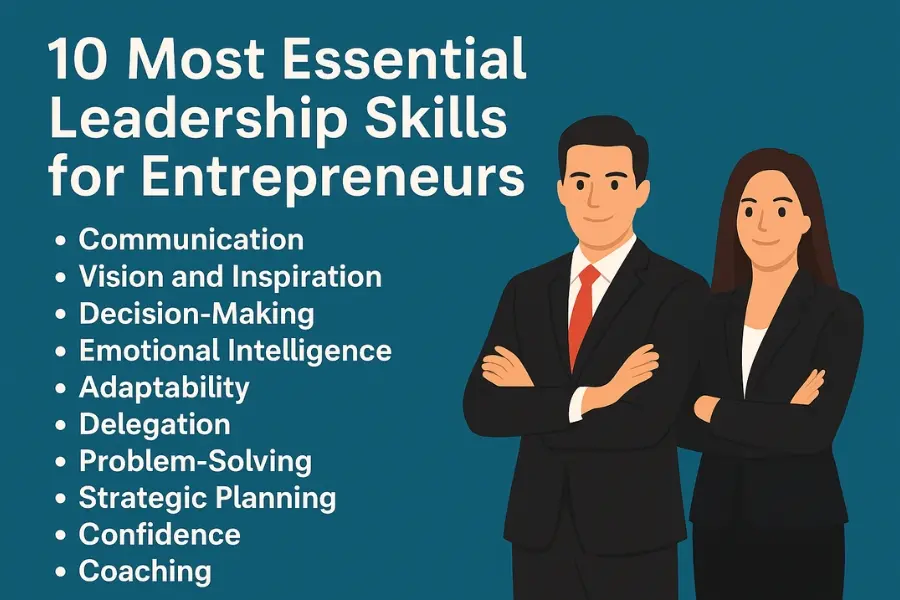
The following are the 10 most essential Leadership Skills for Entrepreneurs that every business owner should master to lead effectively, inspire loyalty, and achieve long-term success.
1. Visionary Thinking: The Foundation of Entrepreneurial Leadership
Every great business begins with a vision. A clear picture of what you want to achieve and how you plan to make it happen. For entrepreneurs, having a vision isn’t just about setting goals; it’s about seeing possibilities where others see obstacles. This ability to think ahead, dream big, and inspire others forms the foundation of effective leadership.
Successful entrepreneurs understand that visionary thinking is what keeps a business focused during challenging times. When you know where your company is headed, you can guide your team with confidence and make informed decisions that align with your long-term mission. Visionary leaders are not afraid to take calculated risks because they see the bigger picture beyond short-term setbacks.
Developing Leadership Skills for Entrepreneurs means cultivating this forward-looking mindset. You must be able to communicate your vision clearly, motivate your team to believe in it, and take consistent steps toward making it a reality. A powerful vision provides direction, fosters unity, and drives innovation. Three vital elements that every successful business depends on.
Take examples from visionary entrepreneurs like Steve Jobs and Richard Branson. They didn’t just build companies; they created movements based on bold ideas. Their leadership inspired people to work toward something greater than profits, a shared purpose. That’s the power of having a vision and leading others toward it.
To strengthen your own visionary leadership:
- Define your company’s long-term mission and core values.
- Communicate that mission frequently to your team and stakeholders.
- Stay flexible, visions evolve, but purpose remains constant.
When your vision becomes clear and actionable, your leadership naturally strengthens. Visionary thinking is not just one of the top Leadership Skills for Entrepreneurs. It’s the skill that drives all others.
10 Management Skills Every Manager Should Have

2. Decision-Making Skills for Business Success
Every entrepreneur faces numerous decisions, from selecting the right business model to hiring the right team or launching a new product. The ability to make smart, timely, and confident decisions can make or break your business. That’s why decision-making is one of the most powerful Leadership Skills for Entrepreneurs who want to lead effectively.
Strong decision-making skills come from a mix of experience, intuition, and analysis. Great leaders know how to balance all three. They use data to support their choices but also trust their instincts when the path ahead isn’t clear. In entrepreneurship, there is rarely a “perfect” answer. Instead, there are strategic decisions that move your vision forward despite uncertainty.
Effective decision-makers understand the impact of every choice on their team, finances, and brand reputation. They take the time to evaluate risks, seek expert opinions, and then act with conviction. Indecisiveness, on the other hand, can slow down progress, create confusion, and weaken your team’s confidence in your leadership.
Here are a few tips to enhance your entrepreneurial decision-making:
- Gather facts: Base your choices on research and reliable data.
- Involve your team: Collaboration often leads to smarter outcomes.
- Trust your instincts: Experience sharpens your intuition; use it wisely.
- Evaluate results: Learn from every decision to refine your process.
Building strong Leadership Skills for Entrepreneurs means developing the courage to decide even when the outcome is uncertain. Remember, in business, hesitation can be more costly than making a mistake. A true leader takes action, learns quickly, and adjusts with confidence.
When your decision-making aligns with your vision and values, your leadership becomes both decisive and inspiring, setting the tone for your entire organisation.
3. Communication: The Core Leadership Skill for Entrepreneurs
Clear and confident communication is at the heart of successful leadership. No matter how innovative your ideas are, they mean little if you can’t express them effectively to your team, partners, and customers. Strong communication builds trust, alignment, and motivation. The three cornerstones of any thriving business.
One of the most essential Leadership Skills for Entrepreneurs is the ability to communicate vision and direction clearly. Entrepreneurs must be skilled at articulating their goals, explaining their strategies, and ensuring every team member understands how their role contributes to the company’s success. When communication flows openly, teams perform better, and decisions are executed more efficiently.
Effective leaders also know that communication isn’t just about talking. It’s about listening. By actively listening to feedback from employees, customers, and investors, entrepreneurs can make more informed decisions and foster stronger relationships. Listening shows respect, encourages collaboration, and fosters a culture of openness and innovation.
To enhance your communication as a leader:
- Be transparent: Share successes and challenges honestly.
- Simplify your message: Make complex ideas easy to understand.
- Encourage feedback: Open dialogue leads to continuous improvement.
- Adapt your tone: Communicate effectively with employees, clients, and partners by tailoring your approach to the specific context.
In today’s digital age, communication extends beyond meetings and emails. It encompasses how you represent your brand online, manage your social presence, and engage with your audience. Entrepreneurs who communicate authentically build credibility and inspire loyalty.
Developing strong communication habits is one of the most impactful Leadership Skills for Entrepreneurs. When you can clearly express your vision and connect emotionally with your team, you don’t just manage a business, you lead a movement.
4. Emotional Intelligence: Leading with Empathy
Behind every successful entrepreneur is a leader who understands people. Their motivations, emotions, and challenges. This ability to recognize and manage both your own emotions and those of others is known as emotional intelligence (EQ), and it’s one of the most transformative Leadership Skills for Entrepreneurs today.
Emotional intelligence enables you to connect with your team on a personal level, fostering an environment of trust, respect, and motivation. When your employees feel heard and valued, they become more engaged, productive, and loyal to your mission. Empathy in leadership doesn’t mean being overly emotional. It means being aware of others’ perspectives and responding thoughtfully.
A high EQ helps entrepreneurs handle stress, resolve conflicts, and make better decisions even under pressure. Instead of reacting impulsively, emotionally intelligent leaders pause, assess, and respond strategically. This approach builds stability and confidence within your team, especially during challenging times.
Here are the key components of emotional intelligence every entrepreneur should develop:
- Self-awareness: Recognize your emotions and understand how they affect your behavior and decisions.
- Self-regulation: Stay calm, composed, and positive in stressful situations.
- Empathy: Understand the feelings and viewpoints of your team and clients.
- Social skills: Build strong relationships and communicate with emotional clarity.
Research shows that leaders with higher emotional intelligence tend to achieve better business outcomes, retain top talent, and create stronger organizational cultures. That’s why developing EQ is one of the most essential Leadership Skills for Entrepreneurs. It transforms you from being just a boss into a leader people genuinely want to follow.
When empathy and emotional awareness guide your leadership, your business becomes more than a company. It becomes a community where people feel inspired to give their best.
5. Adaptability: Thriving in a Changing Business Environment
In today’s fast-paced world, the only constant in business is change. Market trends evolve, technologies advance, and customer expectations shift overnight. Entrepreneurs who can adapt quickly and make flexible decisions are the ones who thrive the most. That’s why adaptability is one of the most crucial Leadership Skills for Entrepreneurs in the modern era.
Adaptability means having the mental agility to embrace change, adjust strategies, and lead your team confidently through uncertainty. Whether it’s pivoting your business model, adopting new technology, or responding to market disruptions, adaptable leaders view change not as a threat but as an opportunity to innovate and grow.
The most successful entrepreneurs, such as Jeff Bezos and Reed Hastings, have built their companies by anticipating change and evolving ahead of their competitors. They continually experimented, learned from feedback, and adjusted their course as needed. This proactive mindset is what separates strong leaders from those who fall behind.
To strengthen your adaptability as a leader:
- Stay informed: Keep up with industry trends, customer behavior, and emerging tools.
- Encourage flexibility: Allow your team to suggest creative solutions and test new ideas.
- Embrace learning: Treat every challenge as a lesson, not a setback.
- Be proactive: Plan for potential disruptions before they happen.
Building adaptability as part of your Leadership Skills for Entrepreneurs allows you to stay calm and decisive even when circumstances change rapidly. It ensures your business remains resilient and capable of turning challenges into opportunities for growth.
Remember, leadership isn’t about controlling every outcome. It’s about guiding your team through change with confidence. The more adaptable you are, the more unstoppable your entrepreneurial journey becomes.
6. Strategic Thinking and Planning Skills
Every successful business is built on a strong foundation of strategic thinking-the ability to see the big picture, set long-term goals, and design a roadmap to achieve them. While creativity fuels innovation, strategy ensures that innovation leads to sustainable growth. That’s why strategic thinking ranks among the most vital Leadership Skills for Entrepreneurs who want to lead with purpose and direction.
Strategic leaders don’t just react to market changes; they anticipate them. They analyze trends, identify opportunities, and make calculated moves that align with their company’s vision. Instead of focusing only on short-term wins, they think years ahead, building a business that’s adaptable, scalable, and resilient.
Entrepreneurs who master strategic planning understand how to allocate resources effectively, prioritize tasks, and create systems that maximize efficiency. This skill helps you balance daily operations with long-term growth, a key challenge for many new business owners.
Here’s how to enhance your strategic thinking and planning skills:
- Set clear goals: Define where you want your business to be in one, three, and five years.
- Analyze data: Make informed decisions based on market research and customer insights.
- Think critically: Evaluate risks and opportunities before taking major steps.
- Review and refine: Continuously assess your progress and adjust your strategy as needed.
Developing Leadership Skills, such as strategic thinking, transforms you into a visionary leader, one who not only leads teams but also guides entire organizations toward long-term success.
Remember, successful entrepreneurs don’t just plan for the future. They create it. Strategic thinking allows you to move from reacting to events to shaping the direction of your business with confidence and clarity.
7. Team Building and People Management
No entrepreneur succeeds alone. Behind every great business is a team of dedicated individuals who bring diverse skills, ideas, and energy to the table. The ability to build, lead, and manage a team effectively is one of the most critical Leadership Skills for Entrepreneurs, and it often determines how far your business can truly go.
Great leaders understand that people are their most valuable asset. Building a strong team begins with hiring individuals who share your vision, values, and commitment. But it doesn’t end there. The real challenge lies in motivating and guiding your team toward consistent performance and growth.
Entrepreneurs who excel at people management create a culture of trust, collaboration, and accountability. They communicate clearly, recognize achievements, and empower team members to take ownership of their work. When employees feel appreciated and supported, they deliver better results and remain loyal to the company’s mission.
Here are a few ways to strengthen your team-building and management skills:
- Hire for attitude and potential, not just experience.
- Encourage open communication and make space for team input.
- Delegate tasks effectively to build confidence and independence.
- Recognize and reward achievements to maintain high morale.
- Invest in professional growth through training and mentorship.
Developing strong Leadership Skills for Entrepreneurs means learning how to balance authority with empathy. The best leaders don’t just manage people, they inspire them. They know when to step in, when to step back, and how to turn challenges into opportunities for team development.
When your team feels valued and empowered, they’ll not only follow your direction but also help you drive innovation and business success. True leadership is not about commanding people. It’s about building people who can stand confidently beside you.
8. Financial Leadership and Accountability
Strong financial management is one of the cornerstones of lasting business success. While many entrepreneurs focus on innovation and growth, true leaders know that financial discipline and accountability are what keep a company stable and sustainable. That’s why Financial Leadership is one of the most important Leadership Skills for Entrepreneurs.
Being a financially responsible leader means more than just tracking revenue or cutting expenses. It’s about understanding how money flows through your business, where it’s earned, where it’s spent, and how it can be reinvested to fuel future growth. Financially savvy entrepreneurs make decisions that strike a balance between short-term needs and long-term goals, ensuring the business remains both profitable and adaptable.
Effective financial leadership requires transparency, strategy, and foresight. When you lead with accountability, you create trust among investors, employees, and stakeholders. Everyone feels confident knowing the company is in responsible hands, guided by smart decisions and ethical practices.
Here are key ways to strengthen your financial leadership:
- Understand your numbers: Learn how to read financial statements and analyze key metrics.
- Set realistic budgets: Align your spending with business priorities and growth targets.
- Track performance: Regularly review financial reports and adjust strategies when needed.
- Be transparent: Share major financial updates with your team and stakeholders.
- Plan for growth: Reinvest profits wisely to ensure sustainable expansion.
Building Leadership Skills for Entrepreneurs in the area of finance doesn’t mean you need to be an accountant. It means developing a mindset of responsibility, foresight, and integrity. Entrepreneurs who lead financially sound businesses not only gain credibility but also create the foundation for lasting success.
Remember, great leaders don’t just make money. They manage it wisely, invest it purposefully, and use it to build a legacy.
9. Delegation and Trust: Empowering Your Team
One of the most overlooked Leadership Skills for Entrepreneurs is the ability to delegate effectively. Many new business owners try to handle everything themselves, from marketing and sales to finance and operations, believing that doing it all ensures success. But in reality, refusing to delegate limits growth, drains energy, and slows progress.
True leaders understand that delegation is not a sign of weakness; it is a sign of strength. It’s a mark of wisdom. By trusting your team with responsibilities, you not only free up your time to focus on strategy and innovation but also give others the opportunity to learn, grow, and take ownership of their roles. Delegation builds confidence, accountability, and efficiency across the organization.
When you empower your team, you create a culture of trust and collaboration. Employees who feel trusted are more likely to take initiative, share ideas, and exceed expectations in their work. This trust becomes the foundation of a motivated and high-performing team, something every successful entrepreneur needs.
To strengthen your delegation and trust skills:
- Identify strengths: Assign tasks based on each team member’s skills and interests.
- Set clear expectations: Define goals, timelines, and success criteria upfront to ensure a smooth process.
- Offer guidance, not control: Support your team while letting them own their own process.
- Provide feedback: Recognize achievements and offer guidance to improve areas where needed.
- Trust the outcome: Focus on results, not micromanagement.
Developing this balance between delegation and leadership is one of the most practical and transformative Leadership Skills for Entrepreneurs. When your team feels empowered and trusted, they become more creative, engaged, and committed to your vision.
Remember, strong leaders don’t try to do everything themselves; they build others who can do great things together. Trust your people, and you’ll multiply your impact far beyond what you could achieve alone.
10. Continuous Learning and Self-Improvement
In the ever-changing world of business, one truth remains constant. Leaders who continue to learn never stop growing. The most successful entrepreneurs understand that knowledge, like leadership, is a continuous journey, not a destination. That’s why Continuous Learning and Self-Improvement stand among the most powerful Leadership Skills for Entrepreneurs.
The business landscape evolves daily, new technologies emerge, customer behaviors shift, and global markets fluctuate. Entrepreneurs who actively seek knowledge stay ahead of these changes and make more informed, smarter decisions. Learning helps you adapt faster, innovate more effectively, and stay competitive in a world where stagnation can quickly lead to irrelevance.
Great leaders are curious. They read books, attend workshops, listen to mentors, and analyze their mistakes to refine their judgment and strategy. They view every success and setback as an opportunity to improve both personally and professionally. This growth mindset is what separates average leaders from exceptional ones.
To cultivate continuous learning and self-improvement:
- Read regularly: Explore business books, leadership guides, and industry news.
- Seek mentorship: Learn from experienced entrepreneurs and thought leaders.
- Reflect often: Evaluate your leadership decisions and identify areas for growth.
- Invest in education: Consider taking online courses or attending professional development programs.
- Learn from failure: View mistakes as lessons, not limitations.
Developing these Leadership Skills for Entrepreneurs ensures that your growth never stops, even when your business succeeds. By constantly updating your mindset, skills, and strategies, you strengthen your ability to lead with confidence, creativity, and resilience.
Remember, the best leaders aren’t those who know everything. They’re the ones who never stop learning. When you grow, your business and team grow with you.
How to Develop Leadership Skills as an Entrepreneur
Becoming a great leader doesn’t happen overnight. It’s a gradual process that requires dedication, self-awareness, and consistent practice. The good news? Anyone can develop strong Leadership Skills for Entrepreneurs by following the right steps and maintaining a growth mindset.
Leadership isn’t about authority; it’s about influence, purpose, and vision. As an entrepreneur, you’re not just managing a business; you’re shaping a culture, inspiring others, and driving innovation. To master these skills, you need to focus on both personal development and business growth.
Here’s how to start developing your Leadership Skills for Entrepreneurs:
1. Set Clear Goals and Values
Define what kind of leader you want to be. Identify your core values. Honesty, innovation, empathy, or teamwork, and let them guide every decision you make. When your goals align with your values, your leadership naturally becomes more authentic and impactful.
2. Practice Effective Communication
Great leaders know how to communicate clearly, confidently, and compassionately. Whether you’re pitching to investors, guiding your team, or addressing clients, communication is your most valuable leadership tool. Listen actively, speak with clarity, and always encourage open dialogue.
3. Learn from Mentors and Role Models
Find successful entrepreneurs who embody the kind of leader you aspire to be. Observe how they make decisions, handle challenges, and motivate their teams. Mentorship accelerates your leadership growth and helps you avoid common business mistakes.
4. Build Emotional Intelligence (EQ)
Emotional intelligence enables you to connect with your team, manage stress effectively, and resolve conflicts more efficiently. Leaders with high EQ can inspire trust, foster stronger relationships, and make informed decisions even in high-pressure situations.
5. Take Initiative and Lead by Example
Leadership isn’t about waiting for opportunities. It’s about creating them. Show initiative, stay proactive, and let your actions inspire others. When your team sees your commitment, they’ll naturally follow your lead.
6. Seek Feedback and Reflect Regularly
The best entrepreneurs constantly evaluate their performance. Ask for feedback from peers, mentors, and employees, and use it constructively. Self-reflection transforms experience into wisdom, a crucial component of mastering Leadership Skills for Entrepreneurs.
By following these steps, you’ll not only enhance your leadership potential but also build the confidence to guide your business toward lasting success. Remember, leadership is a skill that grows stronger the more you use it.
Common Leadership Mistakes Entrepreneurs Should Avoid
Even the most passionate and visionary entrepreneurs can fall into leadership traps that limit their potential and slow business growth. Recognizing and avoiding these pitfalls is essential for developing stronger Leadership Skills for Entrepreneurs and building a motivated, productive team.
Let’s look at some of the most common leadership mistakes and how to overcome them:
1. Micromanaging Your Team
Micromanagement kills creativity, slows productivity, and erodes trust. When entrepreneurs constantly oversee every minor task, it sends a message that they don’t trust their team’s abilities.
Solution: Learn to delegate effectively. Empower your team to make decisions and take ownership of their work. When you trust people, they often exceed expectations.
2. Lack of Clear Communication
Poor communication leads to confusion, frustration, and misaligned goals. Many entrepreneurs assume their team “just knows” what to do, but clarity is crucial for success.
Solution: Communicate openly and consistently. Share your vision, set clear expectations, and listen actively. Strong communication is the foundation of great Leadership Skills for Entrepreneurs.
3. Ignoring Feedback
Leaders who dismiss feedback from employees, mentors, or customers miss valuable opportunities for personal and professional growth. Feedback highlights blind spots that even great leaders can’t see on their own.
Solution: Welcome feedback with an open mind. Encourage team members to share ideas and suggestions. Constructive criticism can be your best tool for continuous improvement.
4. Failing to Adapt or Plan Strategically
The business landscape is always changing. Leaders who resist innovation or fail to plan ahead often find their businesses lagging behind those of their competitors.
Solution: Stay adaptable. Regularly review your strategies, adopt new technologies, and be willing to adjust your approach when necessary. Strategic planning and flexibility are essential components of successful leadership.
5. Neglecting Team Morale and Development
Focusing solely on profits while ignoring your team’s growth leads to burnout and high turnover.
Solution: Invest in your people. Recognize achievements, offer training, and create a positive culture where everyone feels valued. Great leaders grow other leaders.
Avoiding these common mistakes will help you strengthen your leadership skills as an entrepreneur, create a healthier work environment, and drive long-term success. Leadership is not about perfection. It’s about awareness, improvement, and balance.
FAQs
Here are some Frequently Asked Questions and Answers About Leadership Skills for Entrepreneurs.
The most important Leadership Skills for Entrepreneurs include communication, decision-making, adaptability, emotional intelligence, time management, and strategic thinking. These skills enable entrepreneurs to guide their teams effectively, navigate challenges, and make informed business decisions that drive long-term success.
Leadership skills are crucial because they determine how well an entrepreneur can inspire, motivate, and guide others. A strong leader sets the tone for company culture, fosters trust within the team, and ensures that everyone works toward a shared vision. Without leadership, even the best business ideas can fail to take off.
While some people naturally possess leadership traits, most leadership skills can be learned and improved over time. Through mentorship, training, self-reflection, and consistent practice, entrepreneurs can develop qualities such as empathy, resilience, and decision-making that define great leaders.
To develop better Leadership Skills for Entrepreneurs, start by:
- Setting clear goals and values
- Improving communication and listening skills
- Seeking mentorship and feedback
- Building emotional intelligence
- Learning from mistakes and reflecting on progress
Continuous learning and self-improvement are key to becoming a more effective leader.
Some common leadership mistakes include micromanaging, poor communication, ignoring feedback, and failing to plan strategically. These behaviors can hurt team morale and slow growth. Great leaders learn to delegate, listen, and adapt, ensuring their team stays motivated and aligned with the business vision.
Emotional intelligence (EQ) is one of the most powerful Leadership Skills for Entrepreneurs. It enables leaders to understand their emotions, connect with others, manage conflict, and lead with empathy. High EQ fosters trust, loyalty, and stronger team relationships, all of which are critical for business success.
A boss gives orders, but a leader inspires action. Bosses focus on control and authority, while true leaders guide, motivate, and support their teams toward shared goals. Entrepreneurs who lead instead of command create a positive, innovative, and productive work environment.
Leadership has a direct impact on business performance, employee satisfaction, and customer experience. Entrepreneurs with strong leadership skills make better decisions, maintain team morale, and adapt quickly to challenges, leading to faster growth and more sustainable success.
Adaptability allows entrepreneurs to pivot strategies and adjust quickly to market changes or unexpected obstacles. It’s a crucial leadership skill for entrepreneurs in today’s dynamic business world, where flexibility often determines survival and growth.
Entrepreneurs can motivate their teams by recognizing achievements, offering growth opportunities, maintaining open communication, and fostering a positive work culture. When team members feel valued and trusted, they give their best, fueling innovation and success.
Developing Leadership Skills for Entrepreneurs isn’t a one-time task. It’s a lifelong commitment to growth, learning, and improvement. Every challenge faced and every decision made is a step toward becoming a stronger, more effective leader. Remember, great businesses are built by great leaders, and that journey starts with you.
You May Also Like
If you enjoyed learning about Leadership Skills for Entrepreneurs, here are more insightful guides and resources to help you grow as a leader and business owner on BizIdeas.net:
- Common Financial Mistakes to Avoid When Starting a Business
Learn how to avoid the biggest money pitfalls new entrepreneurs face and keep your startup financially healthy. - Time Management Tips for Entrepreneurs
Master productivity, focus on priorities, and get more done every day with effective time management strategies. - Entrepreneurial Success Stories for Motivation
Develop the mindset that separates successful entrepreneurs from the rest. Confidence, persistence, and innovation. - Business Growth Strategies for Small Entrepreneurs
Discover proven tactics to scale your business sustainably and reach your next growth milestone. - Effective Team Management Skills for Startup Founders
Learn how to lead your team, foster collaboration, and build a winning company culture.
Final Thoughts
Strong leadership is the heartbeat of every successful business. Whether you’re running a small startup or scaling a fast-growing company, mastering the right Leadership Skills for Entrepreneurs is what transforms good ideas into lasting success.
Entrepreneurship is a journey filled with uncertainty, challenges, and opportunities. It’s your leadership that keeps the vision alive when times get tough, motivates your team to stay focused, and drives your business forward with purpose. Skills like communication, emotional intelligence, decision-making, adaptability, and continuous learning aren’t just nice-to-have traits. They are essential foundations of long-term growth.
Remember, leadership isn’t about being perfect. It’s about being persistent, humble, and willing to grow. The most influential entrepreneurs are those who lead with authenticity, empower others, and continually learn.
Every business milestone you reach will reflect the strength of your leadership. So, invest in yourself, sharpen your mindset, and continually improve your Leadership Skills for Entrepreneurs.
Your leadership today shapes the success story of tomorrow, and that story begins with you.
Key Takeaways:
- Leadership drives success.
Strong leadership isn’t just about managing people. It’s about inspiring, guiding, and empowering your team to achieve a shared vision.
- Developing Leadership Skills for Entrepreneurs is a journey.
It requires continuous learning, emotional intelligence, adaptability, and clear communication.
- Continuous learning ensures growth.
The most successful entrepreneurs are lifelong learners who evolve with the market and embrace new ideas.
- Lead by example.
Your actions speak louder than your words. Integrity, consistency, and resilience inspire others to follow your lead.
- Avoid common leadership mistakes.
Steer clear of micromanaging, ignoring feedback, and poor communication. Instead, delegate wisely, stay open to improvement, and plan strategically.
- Emotional intelligence matters.
Understanding yourself and your team enables you to manage stress effectively, build trust, and lead with empathy.
- Empower your team.
True leaders lift others. When your team grows, your business grows.
- Leadership evolves with experience.
Reflect on your decisions, learn from failure, and continue refining your Leadership Skills for Entrepreneurs over time.
- Vision and adaptability are key.
The ability to plan and pivot when needed separates successful entrepreneurs from struggling ones.
- Leadership defines culture.
The way you lead shapes your company’s values, productivity, and long-term success.





- For bold: [b]text[/b]
- For italic: [i]text[/i]
- For underline: [u]text[/u]
