Top 15 No-Skill Business Ideas Using Free Online Tools to Make Money Online
Published: 29 Jun 2026
Starting an online business no longer requires years of experience, technical skills, or a large investment. Thanks to today’s free online tools, almost anyone can turn a simple idea into a profitable venture from the comfort of home. Whether you’re a student, freelancer, stay-at-home parent, or someone looking for an extra source of income, there are countless opportunities waiting for you.
In this guide, you’ll discover 15 No-Skill Business Ideas Using Free Online Tools that are easy to start and beginner-friendly. These ideas are designed for people with little to no experience who are willing to learn and take action. With the help of tools like ChatGPT, Canva, Google Docs, and other free resources, you can launch a business without spending a fortune.
The best part is that many of these online business ideas for beginners require zero inventory, minimal startup costs, and can be managed from anywhere with an internet connection. As you gain confidence and experience, you can expand these small ventures into sustainable sources of income.
Let’s explore the best no-skill business ideas using free online tools and find the one that matches your interests, goals, and available time.
Why Start a No-Skill Business Using Free Online Tools?
Starting a business used to mean investing thousands of dollars, renting office space, or learning specialized skills before making your first sale. Today, things have changed dramatically. Thanks to free online tools, anyone with a computer or smartphone and an internet connection can launch a profitable venture. Whether you’re looking for a side hustle, a full-time online business, or a way to generate passive income, there are plenty of no-skill business ideas using free online tools that make entrepreneurship more accessible than ever.
No Large Investment Required
One of the biggest advantages of starting a no-skill business is that you don’t need a huge budget. Many successful online businesses begin with little or no investment, allowing beginners to test ideas without taking financial risks.
Most of the tools you’ll need offer free plans that are more than enough to get started. Instead of purchasing expensive software or equipment, you can use platforms like Canva, ChatGPT, Google Docs, CapCut, and Google Drive to create, organize, and deliver professional work.
With lower startup costs, you can focus on learning, building your portfolio, and attracting your first clients instead of worrying about large upfront expenses.
Learn While You Earn
You don’t have to become an expert before starting your business. One of the greatest benefits of today’s digital economy is the ability to learn while you earn. As you complete small projects and work with real clients, you’ll naturally develop valuable skills in communication, marketing, content creation, and business management.
There are also thousands of free tutorials, YouTube videos, and online communities that can help you improve your knowledge without paying for expensive courses. Every project becomes a learning opportunity that helps you grow both personally and professionally.
Work from Anywhere with an Internet Connection
Many online business ideas for beginners give you complete freedom over where and when you work. Whether you’re at home, in a coffee shop, traveling, or living in a different country, all you need is a reliable internet connection to manage your business.
This flexibility makes these businesses ideal for students, stay-at-home parents, freelancers, digital nomads, and anyone looking for a better work-life balance. You can set your own schedule, choose your clients, and work at your own pace without being tied to a traditional office.
Scale Your Business Over Time
Most successful businesses don’t become profitable overnight, but they can grow steadily with consistency. As your experience increases, you can raise your prices, offer additional services, hire freelancers, or automate repetitive tasks using AI-powered tools.
For example, someone who starts by designing simple social media graphics can later expand into branding packages, content marketing, or digital product sales. This gradual growth allows you to turn a small side hustle into a sustainable online business.
Popular Free Online Tools Anyone Can Use
One reason these businesses are so beginner-friendly is the availability of powerful free business tools. These platforms simplify tasks that once required professional expertise and expensive software.
Some of the most popular tools include:
- ChatGPT – Generate content, brainstorm ideas, and improve writing.
- Canva – Design social media graphics, presentations, logos, and digital products.
- Google Docs & Google Sheets – Create documents, organize projects, and collaborate with clients.
- Grammarly – Improve grammar, spelling, and writing clarity.
- CapCut – Edit videos for social media and marketing content.
- Google Drive – Store, manage, and share files securely.
- Trello – Organize tasks and manage projects efficiently.
- Pexels and Pixabay – Access high-quality royalty-free photos and videos.
These free online tools for business eliminate many traditional barriers to entrepreneurship, making it easier than ever to start a business with no prior skills, gain experience, and build a reliable source of income.
15 FREE Digital Marketing Tools For Your Small Business
1. AI Content Writing Business
If you’re looking for one of the easiest no-skill business ideas using free online tools, starting an AI content writing business is an excellent choice. Today, businesses, bloggers, eCommerce stores, and digital marketers constantly need fresh content for their websites, emails, social media, and product pages. Thanks to modern AI writing tools, even beginners can produce high-quality content with the right guidance and editing.
While AI helps speed up the writing process, your value comes from understanding client requirements, organizing information, and polishing the final content. As you gain experience, you can specialize in blog writing, website copy, email newsletters, product descriptions, or SEO content.
What the Business Involves
An AI content writing business focuses on creating written content for clients using AI as a productivity tool. Instead of writing everything from scratch, you use AI to generate ideas, outlines, first drafts, and research assistance before editing the content into a unique, engaging, and reader-friendly piece.
Common services include:
- SEO blog posts
- Website landing pages
- Product descriptions
- Email newsletters
- Social media captions
- Business profiles
- FAQ pages
- Article rewriting and editing
Many small businesses prefer hiring freelance writers because it’s more affordable than employing a full-time content creator, creating consistent demand for skilled writers.
Free Tools to Get Started
One of the biggest advantages of this business is that you can start with free online tools instead of purchasing expensive software.
ChatGPT
ChatGPT is one of the most useful AI writing tools for beginners. It can help you:
- Generate blog ideas
- Create article outlines
- Write first drafts
- Improve headlines
- Brainstorm marketing content
- Rewrite paragraphs
- Simplify complex information
Remember that AI-generated content should always be reviewed, fact-checked, and edited to make it more original, accurate, and engaging.
Google Docs
Google Docs is a free word processor that makes writing and collaboration easy. You can:
- Write and edit articles
- Share documents with clients
- Receive comments and feedback
- Save work automatically in the cloud
- Access files from any device
Many clients already use Google Docs, making it one of the most convenient tools for freelance writers.
Grammarly
Even experienced writers make grammar mistakes. Grammarly helps improve:
- Grammar
- Spelling
- Sentence clarity
- Readability
- Tone and professionalism
Running every article through Grammarly before delivering it can improve quality and increase client satisfaction.
How to Find Your First Clients
Finding your first client is often the hardest step, but there are many free ways to get started.
Create a few sample blog posts in different niches, such as business, travel, health, or technology, to build a simple portfolio. Then begin promoting your services on platforms like LinkedIn, Facebook groups, and freelance marketplaces such as Upwork or Fiverr.
You can also reach out directly to small-business owners, bloggers, or startups that regularly publish content but may not have dedicated writers. A short, personalized message explaining how your writing can help improve their website or attract more visitors can often lead to opportunities.
As you complete projects and collect positive reviews, getting new clients becomes much easier through referrals and repeat business.
Earning Potential
An AI content writing business has excellent income potential because businesses always need fresh content to attract customers and improve their search engine rankings.
Beginners typically charge between $20 and $50 for a short blog post, while experienced writers can earn $100 to $500 or more for long-form, SEO-optimized articles. Writers who specialize in high-demand industries such as finance, software, healthcare, or digital marketing often command even higher rates.
Once you’ve built a strong reputation, you can expand your services by offering content strategy, SEO optimization, website copywriting, or managing a small team of writers. This makes AI content writing one of the most scalable online business ideas for beginners and an excellent way to build a long-term online income using free business tools.
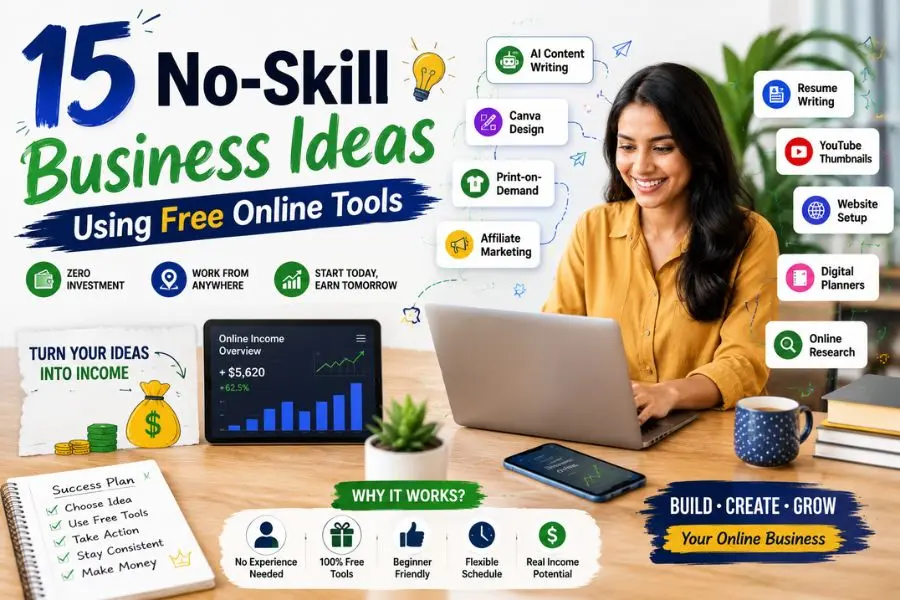
2. Canva Social Media Design Service
If you enjoy being creative, starting a Canva social media design service is one of the best no-skill business ideas using free online tools. Every business wants to maintain a professional presence on platforms like Facebook, Instagram, LinkedIn, Pinterest, and X, but many owners don’t have the time or design skills to create attractive graphics. This creates a great opportunity for beginners to offer affordable design services using free online tools.
The best part is that you don’t need advanced graphic design knowledge. With Canva’s drag-and-drop editor and thousands of ready-made templates, you can create eye-catching designs in just a few minutes.
Why Businesses Need Social Media Graphics
Social media is highly visual, and businesses that post professional-looking graphics often receive more engagement than those that share plain text posts. Well-designed graphics help brands capture attention, communicate their message clearly, and build trust with potential customers.
Businesses regularly need graphics for:
- Instagram posts and stories
- Facebook posts and cover images
- LinkedIn banners
- Pinterest Pins
- Promotional offers
- Product launches
- Event announcements
- Quotes and motivational posts
Since fresh content is needed every week, many companies prefer to outsource this work rather than hire a full-time designer.
Free Tools You’ll Use
One of the biggest advantages of this business is that you can create professional-quality designs without purchasing expensive software.
Canva Free
Canva Free is the primary tool you’ll use. It offers thousands of customizable templates, icons, fonts, and design elements that make creating graphics simple, even for complete beginners.
With Canva, you can create:
- Social media posts
- Stories and Reels covers
- YouTube thumbnails
- Business flyers
- Presentations
- Logos
- Infographics
- Digital products
Its user-friendly interface allows anyone to produce polished designs without having to learn complicated software.
Pexels
Pexels offers a vast collection of free, high-quality photos and videos you can legally use in your client projects. Instead of purchasing stock images, you can download professional visuals that enhance your social media designs.
Pixabay
Pixabay is another excellent resource for free images, illustrations, vectors, icons, and videos. Having access to multiple image libraries gives you more creative options and helps you produce unique content for different clients.
Services You Can Offer
As your confidence grows, you can expand beyond basic graphic design and offer complete social media content services.
Popular services include:
- Instagram post design
- Facebook graphics
- Pinterest Pin creation
- LinkedIn banners
- YouTube thumbnails
- Story templates
- Carousel post designs
- Social media branding kits
- Promotional banners
- Monthly content packages
Offering bundled packages often encourages clients to hire you on a recurring monthly basis instead of ordering one design at a time.
Income Opportunities
A Canva social media design business offers flexible earning potential and can easily grow into a full-time online business. Beginners often start by charging $5 to $15 per graphic or $50 to $150 for small design packages. As you gain experience and build a strong portfolio, you can increase your rates or charge monthly retainers for ongoing content creation.
Many successful Canva designers also generate passive income by selling templates, planners, social media kits, or presentation designs on online marketplaces. This allows you to earn money from the same design multiple times.
If you’re looking for an easy online business idea for beginners, this is one of the most practical options because it combines free business tools, growing market demand, and the opportunity to build a reliable income with very little startup cost.
3. Print-on-Demand Store
Starting a print-on-demand (POD) store is one of the smartest no-skill business ideas that uses free online tools, because you can sell custom products without buying inventory or handling shipping. Instead of investing money in bulk products, you simply create designs, upload them to a print-on-demand platform, and list them in your online store. When a customer places an order, the platform prints the product and ships it directly to the buyer.
This business model allows beginners to launch an online business with low startup costs, focusing on creativity and marketing rather than logistics.
Sell Products Without Inventory
One of the biggest advantages of a print-on-demand business is that you don’t have to purchase products in advance. Traditional retail businesses require you to invest in inventory, manage storage, and handle shipping, but POD eliminates those responsibilities.
You can sell products such as:
- Custom T-shirts
- Hoodies
- Coffee mugs
- Tote bags
- Phone cases
- Posters
- Wall art
- Stickers
- Notebooks
- Hats
Since products are only printed after a customer places an order, you avoid the financial risk of unsold inventory.
Best Free Platforms
Several free online tools make it easy to launch a print-on-demand business without technical experience.
Canva
Canva is perfect for creating eye-catching designs for your products. With thousands of templates, fonts, icons, and graphics available, even beginners can design professional-looking artwork for T-shirts, mugs, posters, and other merchandise.
You can also use Canva to create promotional graphics for your website and social media accounts.
Printify
Printify is one of the most popular print-on-demand platforms. It connects your online store to a network of printing partners worldwide. Once a customer places an order, Printify handles printing, packaging, and shipping, allowing you to focus on growing your business.
Its free plan is ideal for beginners who want to test different product ideas before upgrading.
Printful
Printful is another trusted print-on-demand service known for its high-quality products and seamless integration with platforms like Shopify, Etsy, and WooCommerce. It offers a wide selection of customizable products and handles order fulfillment, making it easy to run your business from anywhere.
Beginner Tips
If you’re new to print-on-demand, start by choosing a specific niche instead of creating designs for everyone. Focusing on a target audience, such as pet lovers, fitness enthusiasts, teachers, gamers, or travelers, makes it easier to attract loyal customers.
Here are a few tips to improve your chances of success:
- Research trending niches before creating designs.
- Keep your designs simple, clean, and easy to read.
- Use high-quality graphics and fonts.
- Create attractive product mockups.
- Promote your products consistently on social media and Pinterest.
- Listen to customer feedback and update your designs regularly.
Remember, building a recognizable brand is often more profitable than simply uploading random designs.
Monetization Strategy
There are several ways to generate income with a print-on-demand store. The most common method is earning a profit margin on every sale. You set your selling price above the product’s production cost, and the difference becomes your profit.
To increase your revenue, consider these strategies:
- Sell through marketplaces like Etsy or your own online store.
- Promote products using social media marketing.
- Write SEO-friendly blog posts to attract organic traffic.
- Partner with influencers in your niche.
- Launch seasonal collections for holidays and special events.
- Offer matching product bundles to increase average order value.
As your store grows, you can expand into multiple niches, launch branded collections, or even build a loyal customer community. With minimal financial risk and access to powerful free business tools, a print-on-demand store is an excellent online business idea for beginners looking to build a long-term source of income.
4. Pinterest Virtual Assistant
Becoming a Pinterest Virtual Assistant (VA) is one of the most overlooked no-skill business ideas using free online tools, yet it offers excellent earning potential. Many bloggers, eCommerce stores, coaches, and small businesses use Pinterest to drive traffic to their websites, but they don’t have the time to manage their accounts consistently. That’s where a Pinterest VA comes in.
You don’t need advanced marketing skills to get started. By learning the basics of Pinterest and using a few free business tools, you can help clients grow their audience while building a flexible online business of your own.
What Pinterest VAs Do
A Pinterest Virtual Assistant helps clients manage and optimize their Pinterest accounts to increase visibility, website traffic, and brand awareness. Most daily tasks are straightforward and become easier with experience.
Typical responsibilities include:
- Creating eye-catching Pinterest Pins
- Writing SEO-friendly Pin titles and descriptions
- Scheduling Pins for consistent posting
- Organizing Pinterest boards
- Conducting basic keyword research
- Monitoring account performance
- Updating old Pins with fresh designs
- Sharing blog posts and product listings
Since Pinterest works more like a search engine than a traditional social media platform, businesses value assistants who understand how to create content that reaches the right audience.
Free Scheduling and Design Tools
You don’t need expensive software to manage Pinterest accounts professionally. Several free online tools provide everything you need to create, organize, and schedule content.
Some of the most useful tools include:
- Canva Free – Design attractive Pinterest Pins using ready-made templates.
- Pinterest Scheduler – Schedule Pins directly inside Pinterest at no cost.
- Google Sheets – Organize content calendars and track publishing schedules.
- Google Drive – Store images and share files with clients.
- Pexels and Pixabay – Download free, high-quality stock photos for Pin designs.
These tools allow beginners to deliver professional results without investing in premium software.
Finding Clients
Landing your first Pinterest VA client may seem challenging, but there are many opportunities available if you’re willing to network and showcase your skills.
Start by creating a small portfolio with sample Pinterest Pins for different industries such as fashion, travel, food, home décor, or business. This demonstrates your creativity even if you haven’t worked with paying clients yet.
You can find clients through:
- Upwork
- Fiverr
- Facebook business groups
- Networking with bloggers and website owners
- Reaching out to small businesses through email
Offering a discounted package or a free Pinterest account audit can also help you build trust and secure your first project. As you gain experience and collect testimonials, referrals and repeat clients often become your primary source of work.
Expected Earnings
A Pinterest Virtual Assistant can earn a steady income because businesses require ongoing account management rather than one-time services. Beginners often charge $15 to $30 per hour, while experienced Pinterest VAs typically earn $35 to $75 or more per hour, depending on their expertise and the services they provide.
Many virtual assistants also offer monthly management packages, which provide recurring income and long-term client relationships. As your knowledge grows, you can expand into Pinterest SEO, content strategy, Pinterest advertising, or complete social media management, significantly increasing your earning potential.
If you’re looking for an online business idea for beginners that combines creativity, flexibility, and free online tools, becoming a Pinterest Virtual Assistant is an excellent way to build a sustainable business from home.
5. AI-Powered Blog Writing Service
An AI-powered blog writing service is one of the fastest-growing no-skill business ideas using free online tools. Millions of businesses publish blog content to attract customers, improve SEO rankings, and build authority in their industries. However, many business owners don’t have the time to write consistent, high-quality articles. By combining AI writing tools with your editing and research skills, you can offer professional blog writing services without years of writing experience.
The key to success isn’t simply copying AI-generated content. It’s using AI to work more efficiently while creating original, valuable, and reader-focused articles that meet your clients’ goals.
Create Blog Posts Faster with AI
Writing a blog from scratch can take several hours, but AI tools can significantly speed up the process. They can help you generate topic ideas, create detailed outlines, suggest headlines, and draft content in minutes. You can then edit, fact-check, and personalize the article to ensure it provides real value.
An AI-powered workflow can help you:
- Generate blog topic ideas
- Create SEO-friendly article outlines
- Write first drafts quickly
- Improve introductions and conclusions
- Rewrite awkward sentences
- Generate FAQs
- Brainstorm meta descriptions and titles
By using AI as an assistant instead of a replacement, you can complete more projects while maintaining high-quality standards.
Essential Free Writing Tools
One of the biggest advantages of this business is that you can get started using free online tools.
Some of the most useful tools include:
- ChatGPT – Generate ideas, outlines, article drafts, and content improvements.
- Google Docs – Write, edit, and collaborate with clients in real time.
- Grammarly – Check grammar, spelling, readability, and writing tone.
- Google Trends – Discover trending topics and popular search interests.
- Google Keyword Planner – Research keywords and search demand for SEO content.
These free business tools allow beginners to deliver professional-quality blog posts without purchasing expensive software.
How Beginners Can Compete
Many beginners believe they can’t compete with experienced writers, but that’s not true. Clients are looking for content that is helpful, well-structured, and optimized for search engines, not necessarily written by someone with decades of experience.
To stand out:
- Build a small portfolio by writing sample articles in different niches.
- Learn the basics of SEO writing and keyword placement.
- Always fact-check AI-generated information.
- Edit every article to make it natural and engaging.
- Focus on solving readers’ problems instead of simply filling pages with words.
- Deliver projects on time and communicate professionally with clients.
Over time, positive reviews and referrals will help you attract higher-paying clients and larger projects.
Pricing Ideas
Your pricing will depend on your experience, article length, and the level of research involved. As a beginner, you can start with competitive rates as you build your portfolio.
A simple pricing structure might look like this:
- 500-word blog post: $20–$40
- 1,000-word article: $40–$80
- 2,000-word SEO article: $100–$250+
- Monthly blog writing packages: Custom pricing based on the number of articles required
As your expertise grows, you can offer premium services such as keyword research, SEO, content strategy, and content updates, enabling you to charge significantly higher rates.
If you’re searching for an online business idea for beginners that requires minimal investment and offers long-term demand, an AI-powered blog writing service is an excellent choice. With the right combination of AI tools, creativity, and continuous learning, you can build a profitable freelance business using free online tools.
6. Digital Planner and Template Business
Starting a digital planner and template business is one of the most profitable no-skill business ideas using free online tools because you create a product once and can sell it repeatedly. Digital products have become increasingly popular among students, professionals, entrepreneurs, and content creators who want ready-made solutions to stay organized or improve productivity.
The best part is that you don’t need professional design skills. With today’s free online tools, you can create attractive and functional planners, templates, checklists, and worksheets in just a few hours.
Create Digital Products Without Design Experience
Many beginners assume they need graphic design expertise to create digital products, but that’s no longer true. Platforms like Canva provide thousands of customizable templates that make designing simple and beginner-friendly.
You can create products such as:
- Digital planners
- Daily, weekly, and monthly calendars
- Budget planners
- Meal planners
- Fitness trackers
- Habit trackers
- Study planners
- Business planners
- Social media content calendars
- Resume templates
- Printable checklists
- Invoice and business templates
By focusing on solving everyday problems, you can create products that people are happy to purchase repeatedly.
Free Design Resources
One of the biggest advantages of this business is that you can create professional-quality products using free business tools.
Some of the best resources include:
- Canva Free – Design planners, templates, worksheets, and printable products.
- Google Docs – Create editable documents, checklists, and planners.
- Google Sheets – Build budget trackers, financial planners, and productivity templates.
- Pexels – Download free, high-quality stock photos.
- Pixabay – Access free icons, illustrations, vectors, and images.
These tools help you create polished digital products without spending money on expensive design software.
Sell on Online Marketplaces
Once your products are ready, you can start selling them on popular online marketplaces with millions of active buyers searching for digital downloads.
Some of the best platforms include:
- Etsy
- Gumroad
- Payhip
- Creative Market
- Shopify (for your own store)
- WooCommerce
To increase your sales, write clear product descriptions, use attractive preview images, and include relevant keywords that help buyers find your products through search results.
You can also promote your products on Pinterest, Instagram, your blog, or through email marketing to drive additional traffic to your listings.
Passive Income Potential
One of the biggest reasons people choose this business is its passive income potential. Unlike freelance services, where you exchange time for money, digital products can continue generating sales long after they’ve been created.
For example, a single digital planner or business template can be sold hundreds or even thousands of times without needing to recreate it. As your product collection grows, your earning opportunities increase as well.
To maximize your income:
- Create products for different niches.
- Bundle related templates into premium packages.
- Update your products regularly.
- Optimize listings with SEO-friendly titles and descriptions.
- Build an email list to promote new products.
- Offer seasonal planners and trending templates throughout the year.
If you’re looking for an easy online business idea for beginners, a digital planner and template business is an excellent option. With free online tools, minimal startup costs, and the opportunity to earn passive income, it’s a scalable business that can grow into a reliable long-term source of online revenue.
7. YouTube Thumbnail Design Service
A YouTube thumbnail design service is one of the most beginner-friendly, no-skill business ideas that uses free online tools. Every day, thousands of YouTube creators publish new videos, and they all need eye-catching thumbnails that encourage people to click. Since many creators prefer spending their time recording and editing videos, they often outsource thumbnail design to freelancers.
The good news is that you don’t need advanced graphic design skills to get started. With free online tools, you can create professional-looking thumbnails that help clients increase their video views and grow their channels.
Why Creators Outsource Thumbnails
A thumbnail is often the first thing viewers notice before deciding whether to watch a video. An attractive and well-designed thumbnail can significantly improve a video’s click-through rate (CTR), making it an important part of a successful YouTube strategy.
Many content creators hire thumbnail designers because they want to:
- Save time on design work
- Maintain a consistent channel style
- Increase video clicks and views
- Improve brand recognition
- Focus on creating quality video content
- Publish videos more consistently
As more businesses and creators invest in YouTube marketing, the demand for thumbnail designers continues to grow.
Free Tools for Beginners
You don’t need expensive software like Photoshop to create professional YouTube thumbnails. Several free business tools provide everything you need to get started.
Some of the best tools include:
- Canva Free – Design professional thumbnails using customizable templates, fonts, and graphics.
- Photopea – A free browser-based photo editor with features similar to Photoshop.
- Pexels – Download high-quality royalty-free photos for your designs.
- Pixabay – Find free images, illustrations, icons, and vectors.
- Remove.bg – Remove image backgrounds in seconds to create cleaner, more engaging thumbnails.
These free online tools make it easy for beginners to produce high-quality designs without any prior experience.
Portfolio-Building Tips
Before approaching clients, it’s important to create a portfolio that showcases your design skills. Even if you haven’t worked with paying clients yet, you can build impressive sample work.
Here are a few ideas:
- Design thumbnails for popular YouTube topics.
- Create before-and-after thumbnail examples.
- Redesign thumbnails from existing videos to demonstrate improvement.
- Build sample thumbnails for different niches such as gaming, business, travel, cooking, fitness, and technology.
- Share your work on LinkedIn, Behance, or your personal website.
A strong portfolio often matters more than years of experience because it shows clients what you’re capable of creating.
Monthly Income Possibilities
A YouTube thumbnail design business can provide consistent monthly income because most creators upload videos regularly and need new thumbnails every week.
Beginners often charge $5 to $15 per thumbnail, while experienced designers may earn $20 to $50 or more for each design. Many freelancers also offer monthly packages, such as creating 20 to 30 thumbnails for a fixed fee, which provides recurring income and long-term client relationships.
As your skills improve, you can expand your services to include YouTube channel branding, banner design, video graphics, or social media content creation, thereby increasing your rates and attracting higher-paying clients.
If you’re looking for an online business idea for beginners that combines creativity, flexibility, and free online tools, a YouTube thumbnail design service is an excellent opportunity with low startup costs and strong long-term demand.
8. Resume and CV Writing Business
A resume and CV writing business is one of the most practical no-skill business ideas to start with free online tools, because people are always looking for better job opportunities. A well-written resume can make a strong first impression and improve a candidate’s chances of getting interviews. However, many job seekers struggle to present their skills and experience effectively, creating a steady demand for resume writing services.
You don’t need to be a professional recruiter or career coach to get started. By learning basic resume formatting, understanding what employers look for, and using free online tools, you can help clients create polished and professional job applications.
Help Job Seekers Improve Applications
The main goal of a resume writing business is to help clients clearly and professionally showcase their qualifications. Instead of simply listing work experience, you’ll organize information to highlight achievements, relevant skills, and career goals.
Your services can include:
- Professional resume writing
- CV formatting and design
- Cover letter writing
- LinkedIn profile optimization
- Resume editing and proofreading
- Career objective writing
- Achievement-focused resume updates
- Interview preparation guides
By offering comprehensive job application packages, you can deliver greater value and increase your earnings.
Free Document and Grammar Tools
You don’t need expensive software to create high-quality resumes. Several free business tools make the entire process simple and efficient.
Some of the best tools include:
- Google Docs – Create, edit, and share professional resumes using free templates.
- Canva Free – Design modern and visually appealing resume layouts.
- Grammarly – Check grammar, spelling, punctuation, and readability.
- ChatGPT – Generate stronger bullet points, improve wording, and rewrite career summaries.
- Google Drive – Store client documents securely and collaborate online.
These free online tools help you deliver polished documents that look professional and are easy for clients to customize later.
Marketing Your Services
Once you’ve created a few sample resumes, it’s time to promote your business. Even without paid advertising, there are many effective ways to attract clients.
Start by:
- Creating a portfolio with sample resumes for different industries.
- Offering resume reviews to friends or family members.
- Sharing career tips on LinkedIn and other professional platforms.
- Joining job seeker and career-focused Facebook groups.
- Listing your services on freelance marketplaces like Upwork and Fiverr.
- Asking satisfied clients for testimonials and referrals.
Building a reputation for delivering high-quality resumes and excellent customer service will help you gain repeat business and word-of-mouth recommendations.
Scaling Your Business
As your client base grows, you can expand your services beyond basic resume writing. Many professionals are willing to pay more for comprehensive career support.
Ways to scale your business include:
- Offering premium resume and LinkedIn optimization packages.
- Creating interview coaching guides and career resources.
- Selling downloadable resume templates.
- Hiring freelance writers to handle additional projects.
- Specializing in resumes for industries such as healthcare, IT, engineering, or executive leadership.
- Building your own website to attract clients through SEO and content marketing.
A resume and CV writing business is one of the most reliable online business ideas for beginners because job seekers are always looking to improve their applications. With the help of free online tools, strong communication skills, and a commitment to helping others succeed, you can build a profitable business with minimal startup costs and long-term growth potential.
9. Affiliate Marketing Content Creator
Becoming an affiliate marketing content creator is one of the most rewarding no-skill business ideas that uses free online tools, because you can earn commissions by recommending products and services without creating your own. Instead of developing physical products, handling customer support, or managing inventory, your role is to create helpful content that guides people toward products they genuinely need.
Whether you enjoy writing blog posts, making videos, or sharing recommendations on social media, affiliate marketing offers a flexible way to build an online income. While it takes time to grow an audience, it can become a reliable source of passive income when done correctly.
Recommend Products Without Creating Your Own
Affiliate marketing works by promoting products or services through a unique referral link. When someone clicks your link and makes a purchase, you earn a commission at no extra cost to the buyer.
You can recommend products in many ways, including:
- Product reviews
- “Best of” comparison articles
- Buying guides
- Tutorials and how-to articles
- YouTube videos
- Email newsletters
- Social media posts
- Resource pages
The key to success is recommending products you trust and creating honest, valuable content that helps readers make informed decisions. This approach builds credibility and encourages repeat visitors.
Free Blogging and Content Tools
You don’t need a large budget to start creating affiliate content. Several free online tools can help you write, design, and organize high-quality content.
Some of the most useful tools include:
- ChatGPT – Generate ideas, outlines, and draft content.
- Google Docs – Write and edit blog posts.
- Canva Free – Design blog graphics, Pinterest Pins, and social media images.
- Grammarly – Improve grammar, spelling, and readability.
- Google Trends – Find trending topics and popular search queries.
- Google Search Console – Monitor website performance and search visibility after launching your blog.
These free business tools allow beginners to produce professional content while keeping startup costs low.
SEO Basics for Beginners
To succeed as an affiliate marketing content creator, it’s important to understand the basics of Search Engine Optimization (SEO). SEO helps your content appear in search engine results, bringing free organic traffic to your website over time.
Here are a few beginner-friendly SEO tips:
- Research low-competition keywords before writing.
- Use your focus keyword naturally in the title, headings, and content.
- Write helpful articles that answer readers’ questions.
- Add internal links to related articles on your website.
- Use descriptive image alt text and optimized meta descriptions.
- Update older content to keep it accurate and relevant.
Good SEO takes time, but it can generate consistent traffic without relying on paid advertising.
Long-Term Earning Potential
Unlike many freelance services that require continuous client work, affiliate marketing has excellent long-term earning potential. A single high-quality article can attract visitors and generate commissions for months or even years after it’s published.
As your website grows, you can increase your income by:
- Publishing more SEO-focused content.
- Promoting products in multiple niches.
- Building an email list.
- Creating comparison guides and buying recommendations.
- Expanding to YouTube or Pinterest for additional traffic.
- Partnering with more affiliate programs.
Many successful affiliate marketers eventually earn enough to replace a traditional job, although it requires patience, consistency, and high-quality content.
If you’re looking for an online business idea for beginners that offers flexibility and the potential for scalable income, becoming an affiliate marketing content creator is an excellent choice. By using free online tools, learning basic SEO, and consistently creating helpful content, you can build a sustainable online business with significant passive income potential.
10. AI Voiceover Business
An AI voiceover business is one of the most innovative no-skill business ideas using free online tools. Thanks to advancements in AI voice technology, you no longer need an expensive microphone, a professional recording studio, or years of voice acting experience to create high-quality voiceovers. Businesses, YouTubers, educators, and marketers are constantly looking for affordable voiceover services, making this a great opportunity for beginners.
While AI generates the voice, your role is to write or edit the script, choose the right voice style, and deliver polished audio that matches your client’s needs.
Create Voiceovers Without Expensive Equipment
Traditional voiceover work often requires costly recording equipment and soundproof studios. With modern AI voice generators, you can create clear and professional voice recordings using only a computer and an internet connection.
You can create voiceovers for:
- YouTube videos
- Explainer videos
- Social media advertisements
- Product demonstrations
- Online courses
- Podcasts
- Audiobook samples
- Business presentations
- Mobile app tutorials
By combining AI-generated voices with basic audio editing, you can deliver professional results without making a significant investment.
Best Free AI Voice Tools
Several free online tools make it easy to start an AI voiceover business.
Some of the most popular options include:
- ElevenLabs Free Plan – Generate realistic AI voices with natural pronunciation.
- PlayHT Free Plan – Create voiceovers in multiple languages and voice styles.
- CapCut – Convert text into speech and edit audio and video files.
- Audacity – Record, trim, and improve audio quality using a free audio editor.
- Canva Free – Create simple videos and presentations that include your voiceovers.
These free business tools allow beginners to produce high-quality audio without purchasing expensive software or equipment.
Clients Who Need Voiceovers
Voiceover services are used across many industries, giving you access to a wide range of potential clients.
Some of your ideal clients include:
- YouTube creators
- Small businesses
- Digital marketing agencies
- eLearning course creators
- Podcast producers
- Mobile app developers
- Social media managers
- Real estate agents
- Freelance video editors
Many of these clients need voiceovers regularly, creating opportunities for recurring projects and long-term business relationships.
Pricing Structure
As a beginner, it’s a good idea to keep your pricing simple while building your portfolio and gaining client reviews.
A common pricing structure includes:
- Short voiceovers (30–60 seconds): $10–$25
- YouTube narration: $25–$75 per video
- Explainer videos: $50–$150+
- Online course narration: Custom pricing based on script length
- Monthly content packages: Fixed rates for clients who need ongoing voiceover work
As your experience grows, you can charge higher rates by offering additional services such as script editing, audio enhancement, background music, synchronized narration, or multilingual voiceovers.
An AI voiceover business is an excellent online business idea for beginners because it combines growing market demand with free online tools and minimal startup costs. With consistent practice, strong customer service, and high-quality audio, you can turn this creative side hustle into a profitable long-term business.
11. Online Research Assistant
If you’re organized, detail-oriented, and enjoy finding information, becoming an online research assistant is one of the most practical no-skill business ideas using free online tools. Businesses, entrepreneurs, bloggers, and marketing agencies often need reliable research but don’t have the time to do it themselves. Instead of spending hours collecting information, they hire freelancers to gather accurate data, organize it, and present it in an easy-to-understand format.
The best part is that you don’t need specialized qualifications to start. With strong internet research skills and a few free online tools, you can provide valuable support to clients in almost any industry.
Research Tasks Businesses Outsource
An online research assistant helps clients save time by collecting and organizing information for various projects. Every assignment is different, making this business both interesting and flexible.
Common research tasks include:
- Market research
- Competitor analysis
- Product research
- Lead generation
- Keyword and content research
- Supplier and manufacturer research
- Industry trend analysis
- Customer feedback research
- Data collection and organization
- Creating research reports
Many small businesses rely on freelance research assistants because it’s more affordable than hiring a full-time employee.
Free Productivity and Research Tools
You don’t need expensive software to provide professional research services. Several free business tools can help you collect, organize, and present information efficiently.
Some of the most useful tools include:
- Google Search – Find reliable information from trusted sources.
- Google Docs – Write organized research reports and summaries.
- Google Sheets – Collect, sort, and analyze data.
- Google Drive – Store and share files securely with clients.
- ChatGPT – Brainstorm ideas, summarize information, and organize research notes.
- Trello – Manage tasks and track project progress.
These free online tools allow beginners to complete projects efficiently while maintaining a professional workflow.
Building Trust with Clients
Since clients rely on your research to make business decisions, trust is one of the most important factors in this business. Delivering accurate, well-organized information will help you build long-term relationships and earn repeat work.
Here are a few ways to establish credibility:
- Verify information using reliable and up-to-date sources.
- Organize findings into clear, easy-to-read reports.
- Meet every project deadline.
- Communicate regularly with clients.
- Ask questions if project requirements are unclear.
- Keep client information confidential.
Satisfied clients are more likely to leave positive reviews and recommend your services to others, helping your business grow through referrals.
Income Expectations
An online research assistant can earn a steady income by working with businesses across different industries. Beginners typically charge $15 to $25 per hour, while experienced research assistants often earn $30 to $60 or more per hour, depending on the project’s complexity.
You can also offer fixed-price packages for tasks such as competitor research, lead generation, or market analysis. As your skills improve, you may expand into business consulting, SEO research, content strategy, or virtual assistant services, thereby increasing your rates and attracting higher-paying clients.
If you’re searching for an online business idea for beginners that requires minimal investment, offers flexible working hours, and supports free online tools, becoming an online research assistant is an excellent option with strong long-term demand.
12. Simple Website Setup Service
Starting a simple website setup service is one of the most valuable no-skill business ideas using free online tools. Every year, thousands of small businesses, freelancers, local shops, and startups need a basic website to establish their online presence. However, many business owners don’t have the time or technical knowledge to create one themselves.
You don’t need to become a professional web developer to offer this service. By learning how to use beginner-friendly website builders, you can help clients launch clean, functional websites while building a profitable online business.
Help Small Businesses Launch Basic Websites
Many small businesses need only a simple website that introduces their brand, showcases their services, and provides contact information. These websites are quick to build and don’t require coding skills.
You can create websites for:
- Local businesses
- Freelancers and consultants
- Restaurants and cafés
- Beauty salons and spas
- Real estate agents
- Fitness trainers
- Photographers
- Tutors and coaches
- Online service providers
- Non-profit organizations
Most basic websites include essential pages such as Home, About, Services, Contact, and a blog or portfolio section.
Free Website Builders
Today’s free online tools make website creation much easier than it was a few years ago. Many platforms offer drag-and-drop editors that let beginners build professional websites without writing code.
Some of the best free website builders include:
- WordPress.com – Great for blogs and simple business websites.
- Google Sites – A free option for creating basic informational websites.
- Wix Free – Offers customizable templates and an easy drag-and-drop editor.
- Canva Websites – Build simple one-page websites quickly.
- Carrd – Ideal for landing pages, personal portfolios, and small business websites.
These free business tools let you practice your skills before offering services to paying clients.
Beginner-Friendly Workflow
One reason this business is perfect for beginners is its simple, repeatable workflow. After completing a few projects, you’ll develop a process that saves time and delivers consistent results.
A typical workflow looks like this:
- Discuss the client’s business goals and website requirements.
- Choose a suitable website template.
- Add the client’s text, images, and branding.
- Create essential pages such as Home, About, Services, and Contact.
- Optimize the site for mobile devices.
- Review the website with the client and make final adjustments.
- Publish the website and provide basic guidance on future updates.
By following the same process for every project, you can complete websites more efficiently and take on more clients.
Upselling Opportunities
Once you’ve finished building a client’s website, you can increase your income by offering additional services. These upsells provide extra value while helping you build long-term relationships with clients.
Popular upselling opportunities include:
- Website maintenance
- Blog setup and content publishing
- Basic SEO optimization
- Logo and branding design
- Social media graphics
- Contact form integration
- Google Business Profile assistance
- Monthly website updates
- Speed optimization
- Content writing services
These recurring services can generate a stable monthly income and reduce the need to constantly find new clients.
A simple website setup service is an excellent online business idea for beginners because it combines growing demand, free online tools, and minimal startup costs. As your confidence and experience grow, you can expand into advanced website design, eCommerce stores, or digital marketing, turning this beginner-friendly service into a scalable online business.
13. Social Media Caption Writing
A social media caption-writing business is one of the easiest no-skill business ideas to start with free online tools, because every business needs engaging content to connect with its audience. While attractive images grab attention, it’s the caption that tells the story, encourages interaction, and motivates people to take action. Many small businesses know they should post consistently on social media but struggle to write compelling captions, making this a valuable service you can offer.
The best part is that you don’t need to be a professional copywriter. With creativity, a basic understanding of marketing, and the help of AI writing tools, you can create captions that help businesses grow their online presence.
Why Businesses Need Engaging Captions
A well-written caption does more than describe an image. It builds relationships with followers and encourages them to engage with a brand. Effective captions can increase likes, comments, shares, and website visits while strengthening customer trust.
Businesses regularly need captions for:
- Instagram posts and Stories
- Facebook updates
- LinkedIn posts
- Pinterest descriptions
- X (formerly Twitter) posts
- Product promotions
- Holiday campaigns
- New product launches
- Customer testimonials
- Educational and inspirational content
Since businesses publish content year-round, caption writing is a service that’s always in demand.
Free AI Writing Tools
You can create high-quality captions quickly using several free online tools. These tools help you generate ideas, improve readability, and maintain a consistent brand voice.
Some of the best tools include:
- ChatGPT – Generate creative captions, calls-to-action, and content ideas.
- Google Docs – Write, organize, and share captions with clients.
- Grammarly – Improve grammar, clarity, and writing tone.
- Canva Free – Pair captions with eye-catching social media graphics.
- Google Keep – Save content ideas and organize inspiration for future posts.
These free business tools help beginners work more efficiently while delivering professional results.
Creating Content Calendars
Many clients prefer working with freelancers who can plan content in advance rather than writing captions one post at a time. By creating a social media content calendar, you can help businesses stay consistent and save them valuable time.
A simple content calendar may include:
- Posting dates
- Caption drafts
- Content themes
- Hashtag suggestions
- Call-to-action ideas
- Image or graphic recommendations
- Seasonal campaigns and promotions
Offering content calendars as part of your service adds more value and makes it easier to secure ongoing monthly projects.
Finding Recurring Clients
The best way to grow a social media caption-writing business is to build long-term relationships with clients who need fresh content every month.
You can find recurring clients by:
- Creating sample captions for different industries.
- Offering free social media content audits.
- Promoting your services on LinkedIn, Facebook, and Instagram.
- Joining entrepreneur and small business communities.
- Listing your services on freelance platforms like Upwork and Fiverr.
- Asking satisfied clients for testimonials and referrals.
As your portfolio grows, many clients will choose monthly content packages rather than one-time orders, providing you with predictable, recurring income.
If you’re searching for an online business idea for beginners, social media caption writing is an excellent option. With the help of free online tools, basic marketing knowledge, and consistent practice, you can build a profitable freelance business while helping companies improve their online engagement and grow their brands.
14. Digital Product Review Blog
Starting a digital product review blog is one of the most scalable no-skill business ideas using free online tools. Every day, people search online for honest reviews before purchasing software, online courses, AI tools, mobile apps, templates, and other digital products. By creating informative and trustworthy reviews, you can help readers make better buying decisions while earning money through affiliate marketing.
Although it takes time to build traffic, a successful review blog can generate passive income for years, making it an excellent long-term online business.
Build a Niche Website with Free Tools
Instead of reviewing every type of product, choose a specific niche that aligns with your interests and maintains consistent demand. A focused website is easier to grow and attracts a more targeted audience.
Popular review blog niches include:
- AI tools
- Productivity software
- Graphic design tools
- Website builders
- Email marketing platforms
- Online learning platforms
- Business software
- SEO tools
- Mobile applications
- Digital templates
You can build your website using free online tools such as:
- WordPress.com – Create a simple blog without coding.
- Google Sites – Build a basic informational website.
- Canva Free – Design blog banners, featured images, and social media graphics.
- Google Docs – Draft and organize your articles before publishing.
Starting with a focused niche allows you to establish authority and build trust with your readers over time.
Write Honest Product Reviews
The success of a product review blog depends on honesty and transparency. Readers appreciate balanced reviews that explain both the strengths and weaknesses of a product instead of sounding like advertisements.
A high-quality review should include:
- Product overview
- Key features
- Advantages and disadvantages
- Pricing information
- Best use cases
- Personal insights or practical examples
- Comparison with similar products
- Final recommendation
Whenever possible, test the product yourself or thoroughly research it before publishing. Honest reviews help build credibility and encourage visitors to return for future recommendations.
Monetize Through Affiliate Marketing
One of the biggest advantages of running a review blog is the opportunity to earn through affiliate marketing. After joining affiliate programs, you’ll receive unique referral links that track purchases made through your content.
You can monetize your blog by:
- Adding affiliate links naturally within reviews.
- Creating “Best Tools” and comparison articles.
- Writing beginner’s guides that recommend useful products.
- Publishing tutorials featuring affiliate products.
- Building an email list to share new recommendations.
- Promoting your articles on Pinterest, Facebook, and other social media platforms.
As your content library grows, your opportunities to earn commissions also increase.
SEO Tips for Long-Term Traffic
To consistently attract free visitors, it’s important to understand the basics of Search Engine Optimization (SEO). Unlike paid advertising, SEO helps your articles rank in search engines and generate long-term organic traffic.
Here are a few beginner-friendly SEO tips:
- Research low-competition keywords before writing.
- Include your focus keyword naturally in headings and throughout the article.
- Write detailed, helpful reviews that answer common questions.
- Add internal links to related articles on your website.
- Optimize images with descriptive file names and alt text.
- Update older reviews whenever products release new features or pricing changes.
SEO requires patience, but once your articles begin ranking, they can continue to attract readers and generate affiliate commissions for months or even years.
If you’re looking for an online business idea for beginners with long-term growth potential, a digital product review blog is an excellent choice. By combining free online tools, honest content, SEO, and affiliate marketing, you can build a trusted website that generates sustainable online income over time.
15. Online Course Resource Creator
Becoming an online course resource creator is one of the most creative no-skill business ideas using free online tools. The online education industry continues to grow, and course creators, teachers, coaches, and trainers are always looking for high-quality learning materials to support their students. By creating digital resources such as worksheets, checklists, templates, and study guides, you can build a business that generates income without managing a full online course yourself.
The best part is that you don’t need teaching experience or advanced graphic design skills. With free online tools, you can create professional-looking educational resources that solve real problems for learners.
Create Worksheets, Checklists, and Study Guides
Your primary role is to create useful learning materials that make online courses more engaging and easier to follow. These resources help students stay organized, track progress, and better understand course content.
Popular digital resources include:
- Printable worksheets
- Study guides
- Course workbooks
- Daily and weekly planners
- Project planners
- Goal-setting templates
- Revision notes
- Checklists
- Flashcards
- Business and productivity templates
You can create resources for many niches, including business, personal finance, fitness, language learning, marketing, productivity, and academic subjects.
Free Design and Document Tools
One of the biggest advantages of this business is that you can create professional digital products using free business tools.
Some of the most useful tools include:
- Canva Free – Design attractive worksheets, planners, and educational templates.
- Google Docs – Create editable documents, workbooks, and study materials.
- Google Sheets – Build trackers, planners, and calculation templates.
- Google Slides – Design presentations and learning resources.
- ChatGPT – Brainstorm content ideas, create quizzes, and generate educational outlines.
- Pexels and Pixabay – Download free images and illustrations for your designs.
These free online tools make it easy for beginners to create high-quality digital products without purchasing expensive software.
Sell Digital Downloads
After creating your resources, you can sell them as digital downloads through popular online platforms. Since customers receive instant access after purchasing, you don’t need to worry about inventory, packaging, or shipping.
Popular platforms for selling digital products include:
- Etsy
- Gumroad
- Payhip
- Shopify
- Creative Market
- Your own website or blog
To increase sales, create attractive product preview images, write detailed descriptions, and optimize your listings with relevant keywords so customers can easily find your products through search.
You can also promote your digital downloads on Pinterest, Instagram, and your blog to drive additional traffic and sales.
Passive Income Opportunities
One of the biggest advantages of this business is its strong potential for passive income. Once you’ve created a digital resource, it can be sold repeatedly without any additional production costs.
To maximize your earnings:
- Create resource bundles for different audiences.
- Offer themed collections for specific industries or subjects.
- Update existing products with new designs and features.
- Build an email list to promote new releases.
- Launch seasonal educational resources throughout the year.
- Expand your collection to cover multiple niches.
As your product library grows, you’ll create multiple income streams that continue generating revenue over time.
If you’re searching for an online business idea for beginners, becoming an online course resource creator is an excellent option. By using free online tools, creating valuable educational materials, and selling digital downloads, you can build a scalable business with excellent passive income opportunities and very low startup costs.
Best Free Online Tools to Start These Businesses
One of the biggest reasons these no-skill business ideas using free online tools are so accessible is the wide range of powerful free software available today. Whether you’re writing content, designing graphics, managing projects, or building a website, you can find reliable tools that help you work professionally without spending money.
Below are some of the best free business tools that can help you launch and grow your online business.
AI Writing Tools
AI writing tools help you create content faster, generate ideas, and improve your writing quality. They’re especially useful for bloggers, freelancers, marketers, and business owners.
Some of the best free AI writing tools include:
- ChatGPT – Generate ideas, outlines, blog posts, emails, and marketing content.
- Google Gemini – Brainstorm ideas, summarize information, and assist with writing tasks.
- Grammarly Free – Improve grammar, spelling, clarity, and readability.
These tools can save time and increase productivity, but always review and personalize AI-generated content before publishing or delivering it to clients.
Graphic Design Tools
Professional graphics are essential for social media, websites, presentations, and digital products. Fortunately, you don’t need expensive design software to create attractive visuals.
Popular free graphic design tools include:
- Canva Free – Create social media graphics, presentations, logos, and digital products.
- Photopea – A browser-based photo editor with features similar to Photoshop.
- Adobe Express Free – Design quick promotional graphics, flyers, and social media posts.
These tools make graphic design simple, even for beginners with no previous experience.
Project Management Tools
Staying organized is important when working with multiple clients or managing different business ideas. Project management tools help you keep track of deadlines, tasks, and ongoing projects.
Recommended free tools include:
- Trello – Organize projects using simple boards and task cards.
- ClickUp Free – Manage projects, create to-do lists, and collaborate with clients.
- Notion Free – Organize notes, business plans, workflows, and project documentation.
Using these tools helps improve productivity and ensures that important tasks are never overlooked.
Productivity Tools
Every successful online business depends on good organization and efficient communication. These productivity tools simplify daily work and improve collaboration.
Useful free productivity tools include:
- Google Docs – Create and edit documents online.
- Google Sheets – Organize data, budgets, and business records.
- Google Calendar – Schedule meetings and track important deadlines.
- Google Keep – Save notes, ideas, and reminders across devices.
These tools help you stay organized while working from anywhere.
Website Creation Tools
A professional website builds trust and helps you showcase your services or products. Thankfully, several website builders offer free plans that are perfect for beginners.
Popular options include:
- WordPress.com – Ideal for blogs and simple business websites.
- Google Sites – Create basic informational websites quickly.
- Wix Free – Build visually appealing websites using drag-and-drop templates.
- Carrd – Perfect for one-page websites and personal portfolios.
As your business grows, you can upgrade to premium plans to access additional features.
Keyword Research Tools
If you want your content to rank in search engines, keyword research is essential. These tools help you discover what your audience is searching for and identify content opportunities.
Some beginner-friendly options include:
- Google Keyword Planner – Find keyword ideas and search volume.
- Google Trends – Discover trending topics and seasonal search interest.
- Keyword Surfer – A free Chrome extension that shows keyword data directly in Google search results.
- Ubersuggest Free – Research keywords and analyze competitors with limited free searches.
Using the right keywords can improve your website’s visibility and attract more organic traffic.
Free Image Resources
High-quality visuals make your website, blog posts, and social media content more engaging. Instead of purchasing stock photos, you can use royalty-free image libraries.
Some of the best free image resources include:
- Pexels – High-quality photos and videos for personal and commercial use.
- Pixabay – Free images, illustrations, vectors, and videos.
- Unsplash – Professional photography for websites, blogs, and marketing materials.
Always review each platform’s licensing terms before using images in commercial projects.
File Storage and Collaboration Tools
Managing files efficiently becomes increasingly important as your business grows. Cloud storage services make it easy to access documents, share files, and collaborate with clients from anywhere.
Reliable free options include:
- Google Drive – Store, organize, and share files securely.
- Dropbox Basic – Keep important documents backed up in the cloud.
- OneDrive Free – Store files online and access them across multiple devices.
These collaboration tools help streamline communication, improve workflow, and ensure your important business files remain safe and accessible.
By combining these free online tools, you can launch almost any of the no-skill business ideas using free online tools featured in this guide. As your business grows, you can gradually upgrade to premium features, but these free versions are more than enough to help you start building a successful online business with minimal investment.
How to Choose the Right No-Skill Business Idea
With so many no-skill business ideas using free online tools, it’s easy to feel overwhelmed. You might be tempted to try several ideas at once, but choosing the right business from the beginning will help you stay focused and increase your chances of success.
The ideal business is one that matches your interests, fits your schedule, has long-term demand, and allows you to learn new skills as you grow. Here are a few important factors to consider before getting started.
Consider Your Interests
The easiest business to stay committed to is one you genuinely enjoy. While you don’t need professional skills, having an interest in the work will make learning much more enjoyable.
For example:
- If you enjoy writing, consider AI content writing, blog writing, or social media caption writing.
- If you’re creative, try Canva graphic design, YouTube thumbnail design, or digital product creation.
- If you enjoy organizing information, an online research assistant or Pinterest Virtual Assistant business may be a better fit.
Choosing a business that aligns with your interests makes it easier to stay motivated, especially in the early stages when you’re gaining experience and finding your first clients.
Match Your Available Time
Before starting any business, think realistically about how much time you can dedicate each week. Some businesses require daily client work, while others allow you to create products once and earn from them repeatedly.
For example:
- Freelance services such as content writing, virtual assistance, and website setup generate income based on client projects.
- Digital products, affiliate marketing, and print-on-demand stores take longer to grow but offer greater passive income potential over time.
If you’re working a full-time job or studying, start with a business that fits comfortably into your schedule. Even 5–10 hours per week can be enough to begin building a successful online business.
Think About Long-Term Demand
It’s tempting to follow short-term trends, but businesses with consistent demand are usually more reliable in the long run. Look for services or products that people will continue needing for years rather than just a few months.
Some examples of businesses with strong long-term demand include:
- Content writing
- Social media management
- Graphic design
- Website setup
- Resume writing
- Affiliate marketing
- Digital product creation
- Virtual assistant services
These industries continue to grow as more businesses move online, creating ongoing opportunities for beginners.
Start with One Business Instead of Many
Many new entrepreneurs make the mistake of launching several businesses at the same time. While this may seem like a good way to increase income, it often leads to confusion, slower progress, and burnout.
Instead, choose one business idea, learn it well, and focus on getting your first few clients or sales. Once you’ve built confidence and developed a steady workflow, you can expand into related services or start another business.
Remember, it’s better to become excellent at one service than average at five.
Build Skills as You Grow
One of the greatest advantages of these no-skill business ideas using free online tools is that you don’t have to know everything on day one. Every project you complete teaches you something new, whether it’s communicating with clients, improving your marketing, or mastering new software.
Continue learning by:
- Watching free YouTube tutorials.
- Reading blogs and industry guides.
- Practicing with free online tools.
- Asking clients for feedback.
- Following trends in your chosen niche.
- Experimenting with new services as your confidence grows.
Over time, the skills you develop will allow you to charge higher rates, attract better clients, and grow your business into a reliable source of income.
Choosing the right online business idea for beginners isn’t about finding the “perfect” opportunity—it’s about taking action on one idea and improving consistently. With patience, dedication, and the help of free business tools, you can turn a simple idea into a successful and sustainable online business.
Common Mistakes Beginners Should Avoid
Starting an online business is exciting, but many beginners make avoidable mistakes that slow their progress or cause them to quit too soon. The good news is that most of these challenges can be avoided with the right mindset and a clear plan.
If you’re exploring no-skill business ideas using free online tools, avoiding the following mistakes will help you save time, stay motivated, and build a stronger foundation for long-term success.
Trying Too Many Business Ideas at Once
One of the biggest mistakes beginners make is trying to launch several businesses at the same time. While it may seem like you’ll earn money faster, constantly switching between ideas often leads to frustration and very little progress.
Instead, choose one business idea that matches your interests and focus on learning it well. Spend your time improving your skills, finding clients, and building experience before expanding into other opportunities.
Remember, successful entrepreneurs usually master one business before starting another.
Ignoring Basic Marketing
Even the best product or service won’t sell if people don’t know it exists. Many beginners spend all their time creating content or designing products but forget to promote them.
Learn the basics of digital marketing, including:
- Social media marketing
- Content marketing
- Basic SEO (Search Engine Optimization)
- Email marketing
- Networking with potential clients
Consistent marketing helps you attract visitors, generate leads, and build trust with your audience over time.
Depending on One Traffic Source
Relying on a single source of traffic can be risky. For example, if all your visitors come from a single social media platform or a single search engine update affects your rankings, your business could lose a significant amount of traffic overnight.
A smarter strategy is to diversify your audience by using multiple channels, such as:
- Google Search (SEO)
- YouTube
- Email newsletters
- Your own website or blog
Building traffic from several sources makes your business more stable and less dependent on any single platform.
Giving Up Too Early
Many people expect immediate results, but most successful online businesses take time to grow. It’s normal to face slow periods, receive few visitors to your website, or struggle to find your first clients.
Instead of giving up, focus on improving a little every week. Continue publishing helpful content, promoting your services, and learning from your experiences. Small, consistent actions often lead to significant long-term results.
Patience and persistence are often the biggest differences between people who succeed and those who quit too soon.
Not Learning New Skills Over Time
Although these are no-skill business ideas that use free online tools, long-term success comes from continually improving your knowledge. The online business world changes quickly, with new tools, trends, and strategies appearing every year.
Make learning part of your routine by:
- Watching free YouTube tutorials
- Reading industry blogs
- Taking free online courses
- Practicing with new AI tools and software
- Following successful entrepreneurs in your niche
- Asking clients for feedback and applying their suggestions
The more valuable your skills become, the more you can charge for your services and the easier it becomes to grow your business.
Avoiding these common mistakes won’t guarantee overnight success, but it will give you a much stronger chance of building a profitable and sustainable online business. Stay focused, keep learning, and remember that every successful entrepreneur started as a beginner. With consistency, patience, and the smart use of free online tools, you can turn a simple idea into a thriving business.
Tips to Grow Your Business Faster
Starting your business is only the first step. To achieve consistent income and long-term success, you need a growth strategy. The good news is that you don’t need a huge budget or years of experience to expand your business. By following a few proven practices, you can attract more clients, build a stronger reputation, and increase your earnings over time.
If you’ve chosen one of these no-skill business ideas using free online tools, the following tips will help you grow faster and create a sustainable online business.
Build a Simple Portfolio
A portfolio is one of the most effective ways to show potential clients what you can do. Even if you haven’t worked with paying clients yet, you can create sample projects that demonstrate your skills and creativity.
For example:
- Content writers can publish sample blog posts.
- Graphic designers can create social media posts and YouTube thumbnails.
- Website setup specialists can build demo websites.
- Resume writers can design sample resumes.
- Digital product creators can showcase planners, templates, and worksheets.
A simple portfolio on your own website, Google Drive, or LinkedIn profile makes it easier for clients to trust your work and hire you.
Use Social Media Consistently
Social media is one of the easiest and most affordable ways to promote your business. Instead of only posting when you’re looking for clients, build a consistent online presence by sharing helpful and engaging content.
You can post:
- Tips and tutorials
- Client success stories
- Before-and-after project examples
- Behind-the-scenes content
- Business updates
- Industry news
- Customer testimonials
Platforms like LinkedIn, Facebook, Instagram, and Pinterest can help you reach new audiences and establish yourself as a trusted professional in your niche.
Ask for Testimonials
Positive reviews build trust and make it easier for future clients to choose your services. After completing a project, politely ask your clients for a short testimonial about their experience.
Display these testimonials on:
- Your website
- Portfolio
- LinkedIn profile
- Freelance marketplace profiles
- Social media pages
Real feedback from satisfied clients acts as social proof, increasing your credibility and improving your chances of winning new projects.
Learn Basic SEO
If you have a website or blog, learning Search Engine Optimization (SEO) can significantly increase your visibility without spending money on advertising.
Focus on simple SEO practices such as:
- Researching relevant keywords
- Writing helpful, in-depth content
- Optimizing page titles and meta descriptions
- Using descriptive headings
- Adding internal links between related articles
- Optimizing images with alt text
- Updating older content regularly
Strong SEO can bring consistent organic traffic and potential customers to your website for months or even years.
Reinvest Your First Profits
One of the smartest decisions you can make is to reinvest some of your early earnings back into your business. Rather than spending all of your profits immediately, use them to improve your tools, skills, or marketing efforts.
Consider investing in:
- Premium software or AI tools
- A custom domain and professional website
- Online courses and skill development
- Better branding and logo design
- Marketing and advertising
- Productivity tools that save time
Small investments made at the right time can help your business grow faster and increase your earning potential in the future.
Growing a successful online business doesn’t happen overnight, but consistent effort produces lasting results. By building a strong portfolio, staying active on social media, collecting testimonials, learning basic SEO, and reinvesting your profits wisely, you’ll create a solid foundation for long-term success. Whether you choose one of these no-skill business ideas using free online tools as a side hustle or a full-time career, these habits will help you stand out from the competition and achieve sustainable growth.
Frequently Asked Questions
Here are some questions and answers about No-Skill Business Ideas Using Free Online Tools.
Yes, absolutely. Many successful entrepreneurs started with little or no professional experience. The purpose of these no-skill business ideas using free online tools is to help beginners earn while learning. You don’t need a college degree, expensive certifications, or years of industry experience to begin.
Today, AI tools, free design platforms, website builders, and productivity apps have made it much easier to launch an online business. What matters most is your willingness to learn, stay consistent, and provide value to your clients or customers.
Start by choosing one business idea, learn the basics through free YouTube tutorials and blogs, practice with free tools, and gradually improve your skills through real projects. Every completed project will increase your confidence and help you build a stronger portfolio.
Remember, successful business owners aren’t born with every skill. They develop them through experience.
There are many excellent free online tools that allow beginners to start a business without making a large financial investment. The right tools depend on the type of business you choose, but several platforms are useful for almost everyone.
Some of the best free tools include:
- ChatGPT for brainstorming ideas, writing content, and improving productivity.
- Canva is free for creating social media graphics, presentations, resumes, planners, and marketing materials.
- Google Docs for writing and collaborating with clients.
- Google Sheets for organizing business data, budgets, and project tracking.
- Google Drive for securely storing and sharing files.
- Grammarly for improving grammar, spelling, and readability.
- Google Trends for discovering popular topics and market trends.
- Google Keyword Planner for basic keyword research.
- Pexels, Pixabay, and Unsplash for royalty-free images.
- Trello, Notion, or ClickUp for project management and task organization.
The good news is that most beginners can launch their first online business using only free versions of these tools. As your income grows, you can decide whether upgrading to premium plans is worth the investment.
Your earnings depend on several factors, including the business model you choose, the amount of time you invest, your marketing efforts, and the quality of your work.
Many beginners earn $100 to $500 per month while learning and building their portfolio. After gaining experience and attracting regular clients, it’s common to earn between $1,000 and $3,000 per month through freelance services such as content writing, graphic design, website setup, or virtual assistance.
Businesses based on passive income, such as affiliate marketing, digital products, print-on-demand stores, and review blogs, usually take longer to grow. However, they also have greater long-term earning potential because they can continue generating income even when you’re not actively working.
Some experienced entrepreneurs who consistently create valuable content, improve their marketing, and diversify their income streams eventually earn five-figure monthly incomes. While these results require patience and dedication, they show the long-term potential of building an online business.
Instead of focusing only on income during the first few months, concentrate on learning, delivering excellent work, and building trust with your audience. Higher earnings naturally follow as your skills and reputation improve.
In most cases, no. Many people begin as freelancers or sole proprietors and register their business later, once they start earning a consistent income. This allows you to test your business idea without incurring legal registration costs before you know whether the business will succeed.
However, business registration requirements vary by country, state, or locality. As your income grows, you should learn about:
- Business registration requirements
- Tax obligations
- Business bank accounts
- Invoicing and bookkeeping
- Required licenses or permits
If you’re unsure about the legal requirements in your area, it’s a good idea to consult a local accountant or business advisor. Starting small is perfectly acceptable, but operating legally becomes more important as your business expands.
Students have limited time, so the best business is one that offers flexibility and can fit around classes or exams.
Some excellent options include:
- AI content writing
- Social media caption writing
- Canva social media design
- YouTube thumbnail design
- Resume writing
- Pinterest Virtual Assistant
- Affiliate marketing
- Digital planner creation
- Online research assistant
- Print-on-demand store
These businesses require very little startup investment and can often be managed using only a laptop and an internet connection.
Students also benefit from learning practical skills such as communication, SEO, marketing, and project management while earning extra income. These skills can improve future career opportunities, whether you continue freelancing or pursue full-time employment.
No. AI tools are incredibly helpful, but they should be viewed as assistants rather than replacements for human creativity and decision-making.
AI can help you:
- Generate ideas
- Write first drafts
- Create outlines
- Improve grammar
- Brainstorm marketing campaigns
- Analyze information
- Save time on repetitive tasks
However, clients and customers still expect accurate, original, and high-quality work. Human editing, creativity, fact-checking, and personal experience are what make your services valuable.
The most successful entrepreneurs use AI to increase productivity while adding their own knowledge, unique perspective, and problem-solving skills. Combining AI with human expertise produces better results than relying on AI alone.
The timeline varies for everyone, but many beginners find their first client within a few weeks if they actively promote their services. Others may take a few months, depending on the niche and how consistently they market themselves.
To improve your chances:
- Create a professional portfolio.
- Offer a few sample projects.
- Optimize your freelance profiles.
- Network on LinkedIn and Facebook groups.
- Reach out to small businesses directly.
- Ask satisfied clients for referrals.
Consistency is key. The more people who know about your services, the faster you’ll increase your chances of landing your first paying client.
Yes. In fact, many successful entrepreneurs begin their online businesses as side hustles while keeping their regular jobs. This approach allows you to earn additional income without relying entirely on your new business.
You can dedicate just 1–3 hours each day or work on weekends to build your portfolio, find clients, and improve your skills. As your income becomes more stable, you can decide whether to continue part-time or transition to running your business full-time.
Starting slowly also reduces financial pressure and gives you more time to learn without taking unnecessary risks.
If your goal is to earn money even when you’re not actively working, focus on businesses that create digital assets rather than selling only your time.
Some of the best passive income ideas include:
- Affiliate marketing blogs
- Print-on-demand stores
- Digital planners and templates
- Online course resources
- Digital product review blogs
- Selling downloadable templates
- Website monetization through display ads
Although these businesses usually take longer to become profitable, they can continue generating revenue for months or even years after the initial work is completed.
The biggest secret isn’t finding the “perfect” business idea—it’s taking consistent action.
Many beginners spend months researching business ideas without ever starting. Successful entrepreneurs usually take a different approach: they choose one idea, begin with the tools they already have, learn through experience, and improve over time.
Focus on these habits:
- Choose one business and stick with it.
- Learn something new every week.
- Practice consistently.
- Deliver excellent customer service.
- Keep improving your portfolio.
- Learn SEO, marketing, and communication skills.
- Use free online tools to work more efficiently.
- Stay patient and don’t expect overnight success.
Remember, every expert was once a beginner. The sooner you start, the sooner you’ll gain experience, build confidence, and create opportunities to grow your online income.
By following the advice in this guide and making the most of these no-skill business ideas using free online tools, you’ll be well on your way to building a profitable and sustainable online business, even if you’re starting with zero experience.
Conclusion
Starting an online business has never been more accessible. As you’ve seen throughout this guide, there are countless no-skill business ideas that use free online tools and require little to no upfront investment. Whether you choose AI content writing, Canva social media design, print-on-demand, affiliate marketing, resume writing, Pinterest virtual assistance, website setup, digital product creation, or any of the other ideas we’ve covered, each business offers the opportunity to build real income while learning valuable skills.
The biggest advantage of these business models is that you don’t have to wait until you’re an expert to begin. Thanks to free online tools like ChatGPT, Canva, Google Docs, Grammarly, Google Drive, and many others, you can start creating, offering services, and improving your work from day one. Every project you complete helps you gain experience, build confidence, and develop skills that increase your value in the marketplace.
Remember, action matters far more than experience. Many people spend months researching business ideas, watching tutorials, and waiting for the “perfect” moment to start. Meanwhile, those who take consistent action, even with limited knowledge, gain practical experience, build portfolios, attract clients, and steadily grow their income. The most successful entrepreneurs aren’t necessarily the most talented; they’re the ones who stay committed and continue improving.
Instead of trying to launch several businesses at once, choose one business idea that matches your interests, available time, and long-term goals. Focus on mastering that business before expanding into additional services or income streams. As your confidence grows, you can increase your prices, automate parts of your workflow, invest in better tools, and even build a team to scale your business further.
It’s also important to remember that building a successful online business is a journey, not an overnight achievement. Some ideas, such as freelance services, may help you earn your first income relatively quickly, while others, like affiliate marketing, digital products, and print-on-demand, require patience before they generate significant passive income. Don’t let slow progress discourage you. Every article you publish, every design you create, every client you help, and every product you launch moves you one step closer to financial independence.
Continue learning as you grow. Improve your knowledge of SEO, digital marketing, communication, customer service, and productivity. Stay up to date with new AI tools and industry trends, and always look for ways to provide more value to your clients or audience. The more problems you solve, the more opportunities you’ll create for yourself.
Most importantly, don’t let a lack of experience stop you from taking the first step. Every successful freelancer, entrepreneur, and business owner started somewhere. With determination, consistent effort, and the smart use of free online tools, you can turn a simple idea into a profitable online business that supports your goals for years to come.
Choose one of these no-skill business ideas using free online tools, start today with the resources you already have, stay consistent, and keep learning. The actions you take now could become the foundation of a reliable long-term online income and a business that continues to grow well into the future.






- Be Respectful
- Stay Relevant
- Stay Positive
- True Feedback
- Encourage Discussion
- Avoid Spamming
- No Fake News
- Don't Copy-Paste
- No Personal Attacks
- Be Respectful
- Stay Relevant
- Stay Positive
- True Feedback
- Encourage Discussion
- Avoid Spamming
- No Fake News
- Don't Copy-Paste
- No Personal Attacks
