How to Run an Effective Weekly Management Review Meeting: A Practical Guide for Business Owners
Published: 26 Nov 2026
Running a business requires more than completing daily tasks and responding to unexpected challenges. Business owners and managers also need a consistent way to evaluate performance, identify problems, review priorities, and ensure that everyone is working toward the same goals. One practical way to achieve this is through a weekly management review meeting.
A well-organised weekly management review helps business leaders understand what is happening across their operations without spending hours on minor details. It creates an opportunity to review key performance indicators, address obstacles, assign responsibilities, and monitor progress from one week to the next.
However, simply scheduling a weekly meeting does not guarantee better business performance. Without a clear agenda, useful information, and documented follow-up actions, these meetings can become repetitive conversations that consume valuable working hours.
The key is to establish a simple, consistent process focused on measurable results, business priorities, and actionable decisions.

In this guide, you will learn how to run an effective weekly management review meeting, select the right key performance indicators (KPIs), prepare a productive 30-minute agenda, identify operational challenges, assign responsibilities, and maintain an action log that keeps your team accountable.
What Is a Weekly Management Review Meeting?
A weekly management review meeting is a scheduled discussion in which business owners, managers, and relevant team members evaluate the organization’s recent performance and determine what needs attention during the coming week.
Unlike general team meetings that may focus on announcements, brainstorming, or daily coordination, a business management review concentrates on performance, important objectives, operational challenges, and decisions.
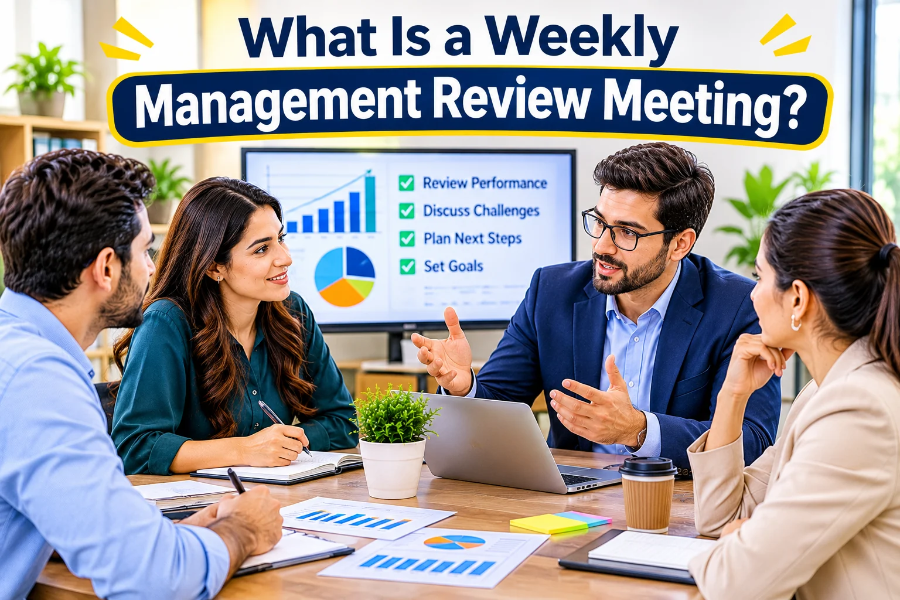
The meeting usually examines information from different areas of the business, including:
- Sales and revenue performance
- Marketing activities and customer acquisition
- Customer satisfaction and feedback
- Financial performance and expenses
- Project progress and deadlines
- Employee productivity and operational efficiency
- Outstanding issues and business risks
For example, a small business owner might use a weekly review to determine whether sales targets were achieved, which marketing activities generated customer inquiries, and why certain customer orders were delayed.
The purpose is not to criticise employees or discuss every individual task. Instead, the objective is to understand the business situation, identify areas that require improvement, and agree on practical next steps.
Why Weekly Management Reviews Matter for Businesses
A business can experience problems even when daily operations appear normal. Sales may gradually decline, project deadlines may be missed, customer complaints may increase, or expenses may grow faster than revenue.
Without a regular review process, these issues can go unnoticed until they become harder to manage.
Weekly management reviews provide a structured opportunity to spot changes and respond before small problems become larger challenges.
1. They Improve Business Visibility
Business owners cannot make effective decisions without understanding what is happening throughout their organisations.
A weekly review brings important information together in one place. Instead of relying on assumptions or occasional updates, managers can examine measurable results and compare them with established targets.
For instance, reviewing weekly sales figures can help a business identify whether revenue is increasing, decreasing, or remaining stable.
2. They Keep Teams Focused on Important Goals
Employees and managers often handle multiple responsibilities simultaneously. Without regular communication, different departments may focus on separate priorities.
A weekly management meeting helps everyone understand which objectives matter most and how their responsibilities contribute to overall business performance.
3. They Help Identify Problems Earlier
Unexpected challenges are part of running a business. These might include supplier delays, customer complaints, technical difficulties, staffing shortages, or marketing campaigns that fail to produce expected results.
Discussing these issues every week gives managers an opportunity to investigate the causes and decide how to respond.
4. They Strengthen Accountability
When responsibilities are clearly assigned, team members understand what they need to accomplish and when the work should be completed.
A review meeting also provides an opportunity to check previously agreed actions and determine whether deadlines were met.
5. They Support Better Decision-Making
Business decisions should be based on relevant information, not assumptions.
By reviewing business KPIs, financial information, and operational updates, managers can make more informed decisions about priorities, resources, and improvements.
How to Choose the Right 5–7 Business KPIs
Key performance indicators (KPIs) are measurable values that help businesses evaluate progress toward specific objectives.
Selecting the right KPIs is one of the most important steps when preparing a weekly management review. Tracking too many measurements can make meetings unnecessarily complicated, while choosing irrelevant indicators may prevent managers from recognising important problems.
For a practical weekly business review, start with five to seven KPIs that reflect your business priorities.
The right measurements will depend on your industry, business model, company size, and current objectives.
1. Revenue or Weekly Sales
Revenue is one of the most useful indicators for understanding business performance.
Reviewing weekly sales helps managers determine whether the business is generating the expected income and moving toward its financial targets.
For example, if a company has a weekly sales target of $10,000 but generates only $7,500, managers can investigate why.
2. Profit Margin
Revenue alone does not show whether a business is financially healthy.
Profit margin helps managers understand how much of the revenue remains after accounting for relevant costs.
A company might increase sales while profitability declines because of rising operating expenses, discounts, or production costs.
Reviewing profit-related measurements can help identify these situations.
3. Customer Acquisition
Customer acquisition measures how effectively a business attracts new customers.
Depending on the business model, useful measurements may include:
- Number of new customers
- Qualified leads generated
- Website inquiries
- New subscriptions
- Customer conversion rate
These figures help managers evaluate whether marketing and sales activities are producing useful results.
4. Customer Satisfaction
Customer satisfaction is important for businesses that depend on repeat purchases, subscriptions, referrals, or long-term relationships.
Managers can review customer feedback, complaints, support requests, survey results, or other relevant measurements.
An increase in negative feedback may indicate problems with product quality, delivery, communication, or customer service.
5. Project Completion Rate
Businesses managing several projects should monitor whether key assignments are progressing on schedule.
Project completion rate, overdue tasks, and milestone achievements can provide useful information about operational performance.
6. Operating Expenses
Monitoring operating expenses helps business owners understand how much they are spending to maintain daily operations.
Common expense categories include rent, software subscriptions, salaries, utilities, transportation, and marketing costs.
Investigate unexpected increases to determine whether they are necessary or require corrective action.
7. Employee Productivity
Employee productivity measurements should reflect actual responsibilities and business objectives rather than simply counting working hours.
Depending on the organisation, managers might review completed assignments, production output, service response times, or project milestones.
The goal should be to identify operational improvements while maintaining reasonable workloads and clear expectations.
Important tip: Don’t select every KPI just because the information is available. Choose indicators that help answer important business questions and support better decisions.
How to Prepare a Simple 30-Minute Meeting Agenda
A structured management meeting agenda keeps a weekly management review focused and prevents discussions from running over.
A 30-minute meeting can be sufficient for a small business or management team when participants prepare their information in advance.
Here is a practical agenda that business owners can adapt to their needs.
First 5 Minutes: Review Previous Action Items
Start by reviewing the tasks assigned at the previous meeting.
Ask three simple questions:
- Which actions have been completed?
- Which tasks are still outstanding?
- What prevented any unfinished work from being completed?
Avoid spending too much time explaining routine updates. Focus on significant delays, unresolved issues, and decisions that require attention.
Next 10 Minutes: Review Business KPIs
Examine the five to seven selected business performance indicators.
Compare actual results with the targets the business set.
For example:
- Did weekly sales meet expectations?
- Did customer inquiries increase?
- Were project deadlines achieved?
- Did operating expenses remain within budget?
- Were customer complaints resolved?
Discuss significant changes and identify measurements that require further investigation.
Next 10 Minutes: Discuss Problems and Priorities
Use this section to examine the most important business challenges.
Each participant should briefly explain relevant obstacles and provide enough information for the team to understand the situation.
Examples might include:
- A marketing campaign generating fewer leads than expected.
- A supplier failing to deliver materials on time.
- A project falling behind schedule.
- An increase in customer complaints.
- Unexpected operating expenses.
Focus on identifying causes and deciding what should happen next, rather than letting the discussion become a lengthy complaint session.
Final 5 Minutes: Assign Actions and Confirm Deadlines
Finish by converting important discussions into specific actions.
Every agreed task should have:
- A clearly defined action.
- One responsible owner.
- A realistic deadline.
- A measurable expected outcome.
Before ending the meeting, briefly repeat the decisions and confirm that everyone understands their responsibilities.
How to Review Business Progress and Identify Blockers
Reviewing business performance is more useful when managers understand why particular results occurred.
For example, if sales decreased during the week, simply recording the decline does not solve the problem. Management needs to investigate possible causes and determine whether corrective action is necessary.
Compare Actual Results With Targets
Start by comparing actual performance with the targets established for the reporting period.
A simple comparison might look like this:
| Performance indicator | Weekly target | Actual result |
|---|---|---|
| Sales revenue | $10,000 | $8,500 |
| New customers | 20 | 17 |
| Customer inquiries | 100 | 115 |
| Completed projects | 10 | 8 |
| Customer complaints | 5 or fewer | 7 |
These figures are illustrative examples, not industry benchmarks.
This comparison highlights differences that deserve attention.
For example, customer inquiries exceeded the target, but sales revenue remained below expectations. This could indicate that the business needs to examine its sales process, lead quality, pricing, or conversion rate.
Identify the Root Causes of Problems
When a KPI falls below its target, avoid immediately assuming that an employee or department has failed.
Investigate the underlying reasons.
Useful questions include:
- What changed during the reporting period?
- When did the problem begin?
- Which factors contributed to the result?
- Does the issue affect other departments?
- What information is needed to better understand it?
- What practical steps could prevent it from happening again?
A root-cause analysis helps management distinguish between temporary difficulties and recurring operational problems.
Separate Urgent Issues From Routine Updates
Not every problem requires immediate management attention.
Some issues can be resolved through normal departmental processes, while others may require additional resources, management approval, or changes to business priorities.
A useful approach is to classify issues into three categories:
Urgent: Problems that could significantly affect customers, revenue, safety, or important deadlines.
Important: Issues that require attention but do not need immediate intervention.
Routine: Minor matters that can be handled outside the management review.
This approach helps teams concentrate on the challenges that matter most.
How to Assign Responsibilities and Deadlines
One of the biggest mistakes businesses make during meetings is discussing problems without assigning responsibility for resolving them.
A discussion may produce useful ideas, but those ideas will not create meaningful results unless someone takes ownership of the necessary actions.
Assign One Clear Owner to Each Action
Every important task should have one primary responsible person.
Other employees can support the work, but one person should remain accountable for ensuring that the assignment progresses.
For example:
Instead of saying, “The marketing team should improve the campaign,” assign a specific action:
“Sarah will review the campaign’s audience targeting and submit three improvement recommendations by Thursday.”
The second statement makes the responsibility and expected outcome much clearer.
Set Realistic Deadlines
Deadlines should reflect the task’s complexity, available resources, and other responsibilities.
Avoid assigning unrealistic completion dates simply to make the action list look productive.
A reasonable deadline helps employees organise their work and allows managers to monitor progress.
Define What Successful Completion Looks Like
A task should have a clear, verifiable outcome.
For example, “Improve customer service” is too broad to measure effectively.
A more practical assignment would be:
“Review the ten most recent unresolved customer complaints and prepare a list of recommended improvements by Friday.”
This provides a specific result that management can review.
Follow Up Without Creating Unnecessary Pressure
Accountability in business management does not mean constantly monitoring every employee.
Managers should establish reasonable progress updates and provide support when someone encounters a genuine obstacle.
The objective is to help the team complete important work, not to create additional administrative pressure.
How to Maintain an Effective Action Log
An action log is a simple record of decisions, responsibilities, deadlines, and task progress.
It connects one weekly management review to the next and helps prevent important commitments from being forgotten.
Businesses don’t need expensive software to maintain an effective action log. A spreadsheet, shared document, or suitable project management application may be sufficient.
What Should an Action Log Include?
A useful action log should contain the following information:
| Action item | Responsible person | Deadline | Status |
|---|---|---|---|
| Review marketing campaign | Marketing manager | Thursday | In progress |
| Contact delayed supplier | Operations manager | Tuesday | Pending |
| Analyze customer feedback | Customer service lead | Friday | Completed |
| Update sales forecast | Sales manager | Wednesday | In progress |
These are sample entries that demonstrate how an action log can be organised.
Update the Log After Every Meeting
Record new assignments immediately after management agrees on them.
Do not rely entirely on memory or informal conversations.
Each task should include enough information for the responsible person to understand what needs to be completed.
Review Outstanding Actions Every Week
At the beginning of the next meeting, examine the previous action log.
Confirm completed tasks, discuss outstanding work, and identify assignments that require revised deadlines or additional support.
If an action remains unfinished for several weeks, management should investigate why rather than carrying it forward indefinitely.
Keep the Action Log Simple
An action log should make business management easier, not create another complicated reporting process.
Avoid unnecessary columns, lengthy explanations, and duplicate records.
A straightforward system that employees consistently update is generally more useful than an advanced system that nobody maintains.
Common Mistakes to Avoid
Even well-intentioned businesses can make mistakes that reduce the effectiveness of weekly management meetings.
Understanding these problems can help organisations establish a more productive review process.
1. Tracking Too Many KPIs
Reviewing dozens of performance indicators can make it difficult to identify the most important information.
Start with five to seven relevant measurements and expand the list only when necessary.
2. Holding Meetings Without an Agenda
An unstructured meeting can easily turn into a general discussion about unrelated subjects.
Prepare a management meeting agenda before the meeting and share it with participants so they know what information to bring.
3. Discussing Problems Without Making Decisions
Identifying challenges matters, but management should also decide what needs to happen next.
Every major issue discussed should lead to a decision, an assigned action, or a clearly defined follow-up investigation.
4. Blaming Employees Instead of Finding Solutions
A productive management review should encourage honest communication.
If employees feel reporting problems will automatically lead to criticism, they may avoid sharing important information.
Focus on understanding the situation, improving processes, and providing appropriate support.
5. Ignoring Previous Commitments
Assigning new tasks every week without reviewing old ones creates confusion and weakens accountability.
Always begin by checking the previous action log.
6. Allowing Meetings to Continue Too Long
Long meetings can reduce productivity and take time away from important operational work.
Use time limits, keep discussions relevant, and move complicated subjects into separate meetings when necessary.
7. Failing to Record Important Decisions
If decisions are not documented, participants may remember different versions of what was agreed.
Maintain a written record of important decisions, responsibilities, and deadlines.
Practical Tips for Productive Weekly Meetings
A few consistent habits can make management review meetings more useful without requiring complicated systems or additional administrative work.
Prepare information in advance: Ask participants to update their KPI figures and action items before the meeting begins. This allows everyone to spend more time discussing results rather than collecting information.
Invite only relevant participants: Include people who understand the business areas being reviewed or are responsible for key decisions. Additional employees can provide written updates when their attendance is unnecessary.
Use a consistent meeting schedule: Holding the review on the same day and at the same time each week makes preparation easier and creates a predictable management routine.
Focus on exceptions: Do not spend equal time discussing every KPI. Give more attention to unusual changes, missed targets, recurring problems, and significant achievements.
Encourage honest communication: Team members should feel comfortable explaining delays, mistakes, and operational challenges. Accurate information helps management make better decisions.
Use simple digital tools: Shared spreadsheets, project management platforms, and business dashboards can help organise performance information and track assignments.
End with clear priorities: Before closing the meeting, confirm the three to five most important priorities for the coming week.
Review and improve the process: Occasionally ask participants whether the agenda, meeting length, and reporting requirements are working effectively. Make adjustments when the process becomes unnecessarily complicated.
A Practical Weekly Management Review Checklist
Business owners can use the following checklist to establish a repeatable weekly management review process.
Before the Meeting
- Prepare updated KPI figures.
- Review the previous action log.
- Identify important performance changes.
- Prepare the meeting agenda.
- Share relevant information with participants.
During the Meeting
- Review previous action items.
- Compare actual results with targets.
- Discuss important business challenges.
- Identify causes of performance problems.
- Agree on priorities and decisions.
- Assign responsible owners and deadlines.
After the Meeting
- Update the action log.
- Share important decisions with relevant employees.
- Communicate deadlines and responsibilities.
- Monitor progress during the week.
- Prepare information for the next review.
Following this checklist helps businesses maintain consistency without turning a simple weekly meeting into a complicated management exercise.
Conclusion
An effective weekly management review meeting helps business owners and managers stay informed, make better decisions, and keep their teams focused on important business goals. By reviewing key performance indicators (KPIs), discussing challenges, assigning responsibilities, and tracking action items, businesses can improve productivity and avoid unnecessary delays.
The key to a successful weekly review is consistency. Keep meetings short, focus on meaningful results, and make sure every action has a clear owner and deadline. With a simple structure and regular follow-ups, your weekly management meetings can become a valuable tool for improving business performance and achieving long-term growth.
You May Also Like
Looking for more ways to improve your business management skills and achieve better results? Explore these helpful guides from BizIdeas.net:
1. Strategic Planning Guide for Business Success
Discover how to set clear business goals, understand your market, develop effective strategies, and create practical action plans. Read our Strategic Planning Guide to learn how to plan and manage your business growth more effectively.
2. Top Productivity Tips for Business Leaders
Learn practical ways to manage your time, improve team performance, organise daily tasks, and make business operations more efficient. Explore these 20 Productivity Tips for Business Leaders to improve your leadership and productivity skills.
3. Keep a Decision Log for Small Catalogue Changes
Discover why documenting business decisions matters for consistency, tracking changes, and improving accountability. Read our guide on Keeping a Decision Log for Small Catalogue Changes to learn how organised decision-making can support better business management.
Explore more practical business guides on BizIdeas.net to strengthen your management skills, make informed decisions, and support long-term business growth.
Frequently Asked Questions (FAQs)
A weekly management review meeting can raise several questions for business owners and managers, especially when establishing a new performance management process. The following answers explain how to organise these meetings, select useful KPIs, and improve business performance.
The main purpose of a weekly management review meeting is to evaluate business performance, identify operational problems, and establish priorities for the coming week. It helps managers understand whether the business is moving toward its goals.
Key objectives include:
- Reviewing important business KPIs.
- Identifying performance gaps and challenges.
- Monitoring employee responsibilities.
- Making informed business decisions.
- Setting priorities for the next week.
A well-organised review meeting helps businesses stay focused, identify problems early, and turn decisions into practical actions.
A weekly management review meeting can often be completed in 30 minutes when participants prepare their information in advance and follow a structured agenda.
A simple meeting schedule may include:
- 5 minutes for reviewing previous action items.
- 10 minutes for reviewing business KPIs.
- 10 minutes for discussing problems and priorities.
- 5 minutes for assigning responsibilities and deadlines.
Larger organisations may require additional time depending on their operational complexity.
The goal should be to make every meeting productive, not unnecessarily long.
For a simple weekly business review, five to seven relevant key performance indicators (KPIs) are a practical starting point. The selected measurements should reflect the company’s main objectives.
Common KPIs include:
- Weekly sales and revenue.
- Profit margin.
- Customer acquisition.
- Customer satisfaction.
- Project completion rate.
- Operating expenses.
- Employee productivity.
Businesses should select indicators according to their industry, size, and priorities.
Tracking fewer meaningful KPIs makes it easier to understand performance and identify areas that need improvement.
A weekly management review meeting should include the business owner or senior manager and employees responsible for important operational areas.
Depending on the organisation, participants may include:
- Business owners or company directors.
- Sales managers.
- Marketing managers.
- Finance managers.
- Operations managers.
- Customer service managers.
Not every employee needs to attend. Invite people who can provide relevant information, make decisions, or take responsibility for important actions.
Keeping attendance relevant helps meetings remain focused and saves valuable working time.
A weekly team meeting generally focuses on communication, task coordination, announcements, and collaboration, whereas a management review concentrates on business performance and strategic priorities.
The main differences include:
- Team meetings: Discuss daily responsibilities, teamwork, and general updates.
- Management reviews: Examine KPIs, business results, operational challenges, and important decisions.
- Team meetings: Coordinate activities among employees.
- Management reviews: Establish priorities, assign accountability, and monitor business objectives.
Both meeting types are useful, but they serve different purposes.
Businesses can benefit from using both formats to improve communication and maintain operational control.
A weekly management report should contain relevant information that helps business owners and managers evaluate performance and make informed decisions.
A useful report may include:
- Important business performance indicators.
- Actual results compared with weekly targets.
- Sales and financial updates.
- Project progress and upcoming deadlines.
- Customer feedback and complaints.
- Operational problems and potential risks.
- Outstanding tasks and action items.
The report should be clear, accurate, and easy to understand.
A well-prepared management report makes weekly meetings more organised and supports better business decisions.
Yes. Small businesses can run effective weekly management reviews without buying expensive software or complex management systems.
They can use simple tools such as:
- Microsoft Excel or Google Sheets for tracking KPIs.
- Google Docs for meeting notes.
- Shared spreadsheets for action logs.
- Basic project management applications for assigning tasks.
- Simple dashboards for monitoring business performance.
The most important requirements are accurate information, a consistent agenda, clear responsibilities, and regular follow-up.
A simple system that a team uses consistently is often more valuable than expensive software that creates unnecessary complexity.
Managers can improve weekly management reviews by following a structured process and encouraging productive discussions.
Some practical ways to improve meetings include:
- Prepare performance information before the meeting.
- Follow a clear 30-minute agenda.
- Focus on five to seven important KPIs.
- Discuss problems instead of hiding them.
- Assign one person responsible for each action.
- Set realistic deadlines for important tasks.
- Maintain an updated action log.
- Review previous commitments every week.
Managers should also encourage honest communication and focus on finding solutions rather than blaming employees.
Consistent preparation, clear accountability, and regular follow-up can turn weekly management reviews into a valuable business management practice.






- Be Respectful
- Stay Relevant
- Stay Positive
- True Feedback
- Encourage Discussion
- Avoid Spamming
- No Fake News
- Don't Copy-Paste
- No Personal Attacks
- Be Respectful
- Stay Relevant
- Stay Positive
- True Feedback
- Encourage Discussion
- Avoid Spamming
- No Fake News
- Don't Copy-Paste
- No Personal Attacks
